Have your voice heard on raw milk debate in Canada

Durham dairy farmer Michael Schmidt was found guilty of selling and distributing raw milk on Wednesday, a decision that overturned his 2010 acquittal.

While it is not against the law to drink unpasteurized milk in Canada, it is illegal to sell it despite the niche demand in Ontario and other provinces.

Health officials maintain that milk must be pasteurized before it is sold, as it can contain pathogens like salmonella, listeria and E. coli – all harmful or deadly if consumed.

But Schmidt, a vocal advocate of food freedom, insists that Canadians shouldn’t be told what they can or cannot drink. He said he won’t give up the fight to endorse and sell raw milk despite the latest court decision.

Like-minded supporters say the pasteurization process kills beneficial micro organisms that aid in digestion and metabolization, among other arguments in favour of the milk.

Do you think people who want to drink raw milk should be able to buy it, if they understand the risks? Should farmers face jail time if they disobey the law? Have you or would you drink unpasteurized milk?

http://www.cbc.ca/news/yourcommunity/2011/09/should-raw-milk-be-sold-in-canada.html#pd_a_5543872

4 Comments

Filed under Food Security, Food Sovereignty, Heritage foods, Milk preservation techniques, personal food sovereignty, Politics of Food, Uncategorized

Word on the Street!

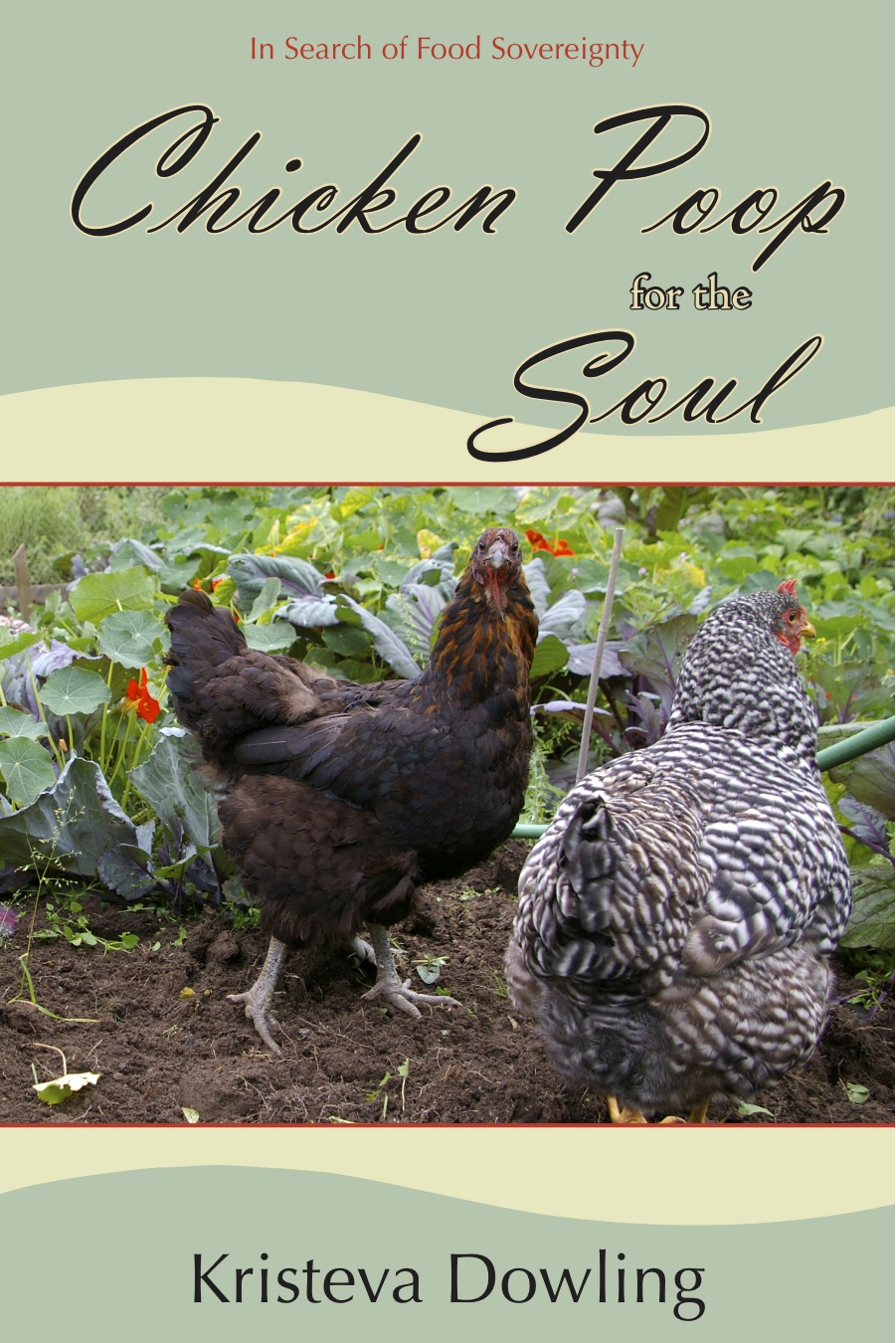
On Sunday, Sept 25th, I will be in the Author’s tent at the National Book and Magazine Festival, Word On The Street, in Vancouver, BC speaking about Chicken Poop For The Soul! You can find me here.

2 Comments

Filed under Uncategorized

HDR Moves North, Part Two

The Arrival:

Is this where I get out?

Having loaded the goats first thing in the morning before leaving Howling Duck Ranch, once Nick was installed in the rear, I was set to go. Originally, I had thought about over nighting in Williams Lake. I phoned the Veterinary Clinic there to see if this was possible. It was in theory but because it was a Sunday, I would have to get there before by 5 pm when they closed. In light of the fact I had to conquer The Hill and get 458 kms of rough road behind me, I just couldn’t see how I could to it. Also, I was still tired from the trip in and needed to visit a few more people before leaving town. I realized, talking with the clinic, that I was going to have to do the trip in one go.

Tens hours into the journey, I stopped in Quesnel for a Tim Hortons coffee. I wondered if Nick needed a break from being cooped up but worried about the wisdom of letting him out. After all, what would I do if I couldn’t get him back into the trailer? What would Claire do, I wondered. Rex (the Vet) had told me that I could safely drive with the animals for 36 hours. But, because I knew I had nearly 24 to do, and I worried that if I had a flat or some other vehicle trouble, we could easily get over that time limit and then what would I do? Finally, I decided to risk it.  I walked him around a field for about twenty minutes while he sniffed the night air and fed on the grass. When it was time to load him back up, again, lovely boy that he was, he went in without any drama.

Nick's first minutes on Couplands farm. I'm talking with Rex about how to integrate him into his herd.

Twenty-two hours of total driving time later, I was at Rex’s just outside Grande Prairie on Saskatoon Mountain. I unloaded Nick and introduced him to Rex’s herd, Dusty and Bo. Rex was certain that Dusty would create a fight, or at least a bit of a horse rodeo so Rex asked if I would stay for a while just in case. I assured Rex that I thought Nick would integrate nicely and not cause any fuss. I took Nick into the pasture and turned him loose. Just as Rex suspected, Dusty was the first to run up to greet him. She pranced around Nick trying to stir the pot. Nick put his ears back once and turned his bum to her. “Well, I think that’s all the show we’re going to see today Rex,” I said. Rex was unconvinced, “I’m sure there’s going to be some trouble. Dusty is a bit of a terror. She seems to get other horses whipped up. I’ve seen it before!” And so we waited. And, we waited some more. And nothing happened. Finally, Rex visibly relaxed and I headed to the next farm to unload my goats. “I’ll call you later to see how things are going,” I said before getting into the truck.

Within minutes of being let loose into the paddock with his new herd mates, Nick is happily integrated.

Not more than two miles down the road, I saw something odd. There was a vast number of deer bunched up along the brush line just off the road. I wondered why they were all clumped up like that until I saw a flicker out of the corner of my eye. Not more than 30 yards in front of them was a full grown cougar laying like a house cat in the snow. His tail flicking in concentration every now and then. I pulled over to watch the scene and called Rex. “Really? In nearly thirty years of living up here I’ve never seen a cougar. Trust you to see one in your first five minutes of being here!” I didn’t wait for Rex to get to the scene but moved on with my load. To this day, Rex still has not seen a cougar. He’d moved off before Rex got to the scene of the crime. A few hours later Rex called to say that Nick and Dusty and Bo were all acting like they’d known each other forever.

Thirty minutes later I pulled up to Russ and Brenda’s farm and unloaded the goats. I introduced my ‘Group of Seven’ into their herd, and then there were 60. Theirs had just had kids so there were goats of all shapes, sexes, and sizes in the mix along with one token guard llama, Gibbs. So devoted to his job was he that he would not let my goats into the feeding area. Russ eventually had to have a talk with him and let him know his job duties extended to the seven newcomers!

My 'Group of Seven' follow me like perfect little citizens into their new home.

Today, I farm sit at both places and look after my own and others’ animals. I have farm sat for Russ and Brenda a few times and gotten to look after their livestock. Before that I had never taken care of cows. It was a unique opportunity for me.  Presently, Rex and Debbie are away and I’m sitting their farm. It is a beautiful place on the mountain. Best of all, I get to see my horse every day. These opportunities not only make me happy but also they let me play farmer.

Fatty-Fat coming in for a pet.

I'm very happy to have my animal family united with me after 18 long months!

7 Comments

Filed under Animal issues, Developing Community, Horses

Howling Duck Ranch Moves North, Part One

After conquering 'The Hill' and several hours of the poor Chiclcotin blacktop, it was time to stop for a much needed rest for everybody.

Here’s to good friends old and new–thank-you all:

Some would say I seem to have a knack for meeting interesting people. I would say I get terribly lucky with who shows up in my life! After many months of being alone here in Grande Prairie, Alberta, I finally have my beloved goats and horse with me. The are now safely installed and well looked after on two different farms. How did this happen?

One night around 2:30 am, one of the Nurses I was working night shift with leaned across the table and asked, “So what else do you do besides work here?” I couldn’t have asked for a better entree. Without a word I flicked on the computer and showed her my blog.

We spent the next few hours getting much work done (not) and learning a whole lot about each other. As it turns out, we are kindred spirits. She has married a farmer and despite her city background now finds herself  knee deep in cow poop, often. Cuz, life on a farm is always about poop! Hence the title of my book. But I digress.

I can’t remember if it was actually that night or soon thereafter that she offered not only a place for my goats to live but also the loan of her stock trailer to get them here.  I couldn’t believe my ears, or my luck. She then took me to her farm to meet her husband, her son, and her variety of barn animals: cows, goats, horses, and token llama. These folks lent me their stock trailer without hesitation or acceptance of payment. But they did wonder if I could perhaps look after their place when they went away later than month? “Later this month, later next month, and any other time you want to go!”

Once the idea of moving my horse and goats was transformed by my new friend from a fantasy to a real possibility, I asked my friend Rex  (who I’d met very briefly along with his wife years ago at another friend’s place and whose farm I moved up here to look after for 5 weeks last summer) if he was really serious last year when he said I was welcome to bring Nick to his farm. “Of course you can. I just can’t promise nothing will go wrong out here. It’s got older fencing and barbed wire and who knows what else in the field,” he cautioned, more I hope to console himself than to warn me. He does after all have two of his own horses on the land and it quite meticulous about keeping his place up. Moreover, he is a Vet. I decided I would risk  it and bring Nick here!

It was a whirlwind trip and I barely had time for two nights at Howling Duck Ranch. I did manage to get a visit in with a couple of  good friends from the valley, Clarence being one of them. We had a pancake breakfast reunion. Something a few of us used to get together to do when I lived there. It was too short a visit but better than no visit at all. The next day I was up early, loading the goats, and heading to the barn where Nick was kept.  I was looking forward to seeing my friend’s husband. I was not looking forward to not seeing her. Clare had developed Rolling Pigeon Ranch over many years in the valley and I met her when I decided to take up horse back riding lessons. Clare died far too young last December and I’d not been able to get to her funeral. She is the first friend that was part of my day to day life (up until leaving the valley) that I have lost. Coming to the valley and visiting with her husband was an emotional reunion for both of us. I finally got a chance to grieve her with someone who knew her and loved her too. It was a bittersweet, but much needed, visit for me.

How l like to remember Clare. She was at her best while instructing riding on her own hand made trails.

The only time I’ve ever trailered Nick, Clare was there to do the work for me. I could rely on her know-how and just be the heavy lifter! Today however I would be doing it for the first time alone and I was nervous about it. We had a long, long trip ahead of us and, to date, I’d only done a 5 hr journey with Nick when Clare was at the helm. Before I tried to get him in the trailer, I looked up at the sky and said quietly, “Clare, I’m going to need your help with this.” Then I opened the doors and walked Nick into the trailer. It was that easy. “Thank-you,” I whispered skywards as I closed the doors and latched them closed. And just like that we were on our way.


2 Comments

Filed under Animal issues, Developing Community, Horses, Learning to Farm

My book is finally complete!

Well it’s taken a long time for me to get this book finished but it’s finally done and out in the stores for sale! This is thanks to the hard work of the Caitlin Press Publishing crew. I am very happy with how it turned out. Vici (the owner of Caitlin Press) said she wanted to try to get it in color but was not sure it would be possible. But she managed the impossible and it looks great. There are many color photos inside that illustrate what I was up to. Some you will have seen on this blog and some are new.

It was a nice surprise to wake up to a box of my very own book on my front porch last week. Even funnier surprise to hear that my mum bought a copy for my dad for Father’s Day!

11 Comments

Filed under Books, Educational, Food preservation, Food Sovereignty, Hunting, Learning to Farm, personal food sovereignty, Politics of Food, Recipes, Uncategorized

Blogline dating?


Goose peperoni shot by Kevin and prepared locally.

Nearly two years ago, not long after I began blogging, a fellow blogger commented on one of my posts. Because I enjoy seeing what other food enthusiasts are up to, I checked out who he was. Kevin Kossowan is a food writer/blogger extraordinaire from Edmonton with an unprecedented passion for all things food and drink. When I clicked on his site I immediately began salivating. It was, quite simply, love at first read. Instantly, I became a devout fan of his blog and spent many reads fantasizing about actually being fed by this man. After several months of quiet devotion, I left a subtle comment, “When can I come to dinner?”

Fast forward 18 months or so and I find myself in Alberta on a cattle drive. Not long after posting that story I received a lovely suggestion, “If you ever get to Edmonton let me know. It would be nice to meet you,” Kevin Kossowan. My first thoughts were: Meeting would be nice, yes. But for the love of god man will you cook me dinner? I wrote him what I hope was a slightly more tactful email than my thought train. He responded with great kindness and generosity which I have come to know is quintessentially Kevin: “1000 times yes!”

Three weeks later I arrived at his doorstep with this deal hashed out: he would feed me and I would help him make apple wine. When he came out to greet me I stuck out my hand to shake his. He looked down at my outstretched arm and nonchalantly batted it away, “I’m a hugger,” he said, then, he helped me with my bags.

“We don’t have a spare room set up yet,” he said over his shoulder as he lead me down the stairs to his basement. “Our facilities are pretty rudimentary but something tells me of all  the people I know, you’ll be able to handle it!” I came down the stairs and ‘my room’ came in to view. There in the middle of his basement was a small bubble tent replete with blankets, pillows, and ‘emergency’ flashlight! My dog was thrilled. She jumped into the tent as if she owned the place and turned to me with a look that said, “Wow, this whole room is ours… you coming in?”


One off my bucket list: Kevin Kossowan cooks for Kristeva!

I’d driven for five hours to get to Kevin’s (all the while dredging up juicy images from his blog and mopping them up with the crusts of my mind) so needless to say I was hungry when I arrived. He introduced me to his wife and children. We took a tour of his yard-garden (which has won ‘edible garden’ recognition by the city of Edmonton). The kids played with Tui until bedtime, when both children and dog were wore out! Finally, his wife and I sat at the dinner table while Kevin prepared the meal.


Local cheeses bought at the farmer's market.

It was everything I’d hoped it would be: there were myriad cheeses to be tasted, wines to be quaffed, and several beautifully presented exquisite little courses of home grown and locally sourced food to be savored.

The meal was topped off with a creme brullee, which of course, having a ‘sweet-tooth’, I decided it was a divine finish to a wonderful evening. I only wish I’d taken a photo of that!


4 Comments

Filed under Developing Community, Kristeva's Kitchen

A grizzly end to self-sufficiency

Well, the inevitable has happened. It was a dry summer, so not  many berries around for our ursine co-inhabitants here in this remote rainforest valley. In addition, the fish runs were down. Then last weekend we had our fifty-year flash flood, which swept away both fish and berries, and blurred the notional “boundary lines” which the officials fondly imagine keep humans from bears/cougars and keep the peace. For the last month there have been intimations that those boundaries were about as effective as Chamberlain’s piece of paper in 1939: neighbours reported seeing a grizzly bear routinely ambling around my property; my husband (who is tending the farm while we decide what to do with it and our lives) eventually saw him/her sitting thirty meters from my house, across the grass and orchard, behind the two boundary fences, calmly surveying the pickings. The next night he made his move and broke the main branches on my two pear trees and apple trees. David reported the attack to the RAPP centre in Kamloops and also crosses the road to the Ministry of Earth and Water, where a generous parks official lent me an electric fence, which friends and he set up encircling the orchard; meanwhile we picked almost all the remaining fruit. He thought about ringing our year old $22 000 chicken barn instead, but felt it was as solid as a building could be.

Two weeks later he heard that at least two neighbours down the highway had their chicken houses ransacked and lost their entire flocks. Then the floods hit, and everyone was preoccupied with surviving, then with trying to save their possessions, cars, houses, fences, bridges, stock, food. That same night one of my egg customers phoned to warn about these attacks and offered the use of her gun; frankly, she said, she wanted to protect her food supply.

David decided to move the electric fence, but was suffering a back injury and decided to postpone it until the weekend and some more healing had first taken place. Meanwhile he increased the lights and radios around the chicken house, and stowed away and secured the bags of feed even more securely behind at least two four inch thick doors.

The following night around 11  pm he heard the scream of a hen. There was a new moon so it was black outside, but from my house he could see an illuminated side of the chicken shed about two metres  away and he could see no commotion. He could only guess that the bear had entered from the side, the weakest side of course. Without a dog or gun, surrounded by neighbours, with the flooded slough still saturating the ground all around, he could do little besides yell “shoo bear!” and bang some pots and pans. Later that night he heard more shrieks, but at dawn my restless fears were allayed when he heard the familiar cock crow. Unlike Peter, he felt relieved of his guilt–until he dressed and went down to let them out to free range, and discovered the side door ripped open, and a line of carcasses stretching through the broken page wire fence and under the trees towards the neighbour’s lawn. Inside, the remainder of my flock were traumatised, the biggest rooster hobbling about with one wing extended, a claw puncture mark on his back. There was even one dead chicken, otherwise untouched, inside the hen house.

He reported the attack to Kamloops (a mere 743 kms drive away) and was contacted at work later that day by our Conservation Officer who by good fortune had just made it back into the valley that day. They rendezvoused at 6 pm and David showed him the wooden barricade  had erected overt the broken door. The CO laughed and said a grizzly would toss that side with his little ginger, literally.

“That’s what I feared,” Davie confessed, “but I have no other defence save the electric fence. And that seems so puny.”

“Actually that’s the best defence,” he said. They tracked the bear scat and chicken bodies across my neighbour’s property and back into the bush which stretches a hundred meters to the highway. He didn’t want to go any further.

“So,” David quite rightly asked, “since you’re staying nearby, when I see the bear tonight I’ll phone you and you can come and shoot it?”

“I wish I could, but no,” he sighed again. “If the fence is broken, then I can.”

“So twenty carcasses, a ravaged chicken house and a loss of livelihood aren’t enough.”

“You got it. Ministry policy. I must obey. If he attacks your goats, on the other hand, then I can shoot.”

“Who makes these rules?”

Apparently, he shrugged with–what I hope was–embarrassment and turned away.

David spent the next three hours and into the darkness moving the electric fence to surround my chicken house. My remaining flock reluctantly returned to the scene of the crime except for one canny rooster which, for a time, tried to roost in a nearby tree. David left them to the tender mercies of the night, the barricaded door and turned on the electric current, and hoped for the best.

That was last night. At dawn they were all still safe, but the biggest rooster was barely dragging himself around. David did, however, find bear scat outside my living room window on the grass and in front of the goat gate ten meters across from my house. He noticed the wooden superstructure above the five foot log railing fence (which I had erected to dissuade the goats from jumping out) had been broken down. I have seven pygmy goats now, and five get moved every night out of their pen and into their locked quarters in the nearby barn; the two grown boys like to take their chances in their run. They were safe, but I wonder for how long. Part of me dreads going out tomorrow morning and finding two goat carcasses by the fence; the other part looks forward to it so that then I will have reason to get the CO to shoot the grizzly.

Or maybe I should work with the current capitalist regime, move back to the farm, and put a sign at my gate saying: “BEAR VIEWING STATION: see the grizzly at close quarters as it kills chickens, smashes fruit trees and rips apart pygmy goats–LIVE! P.S.: Since my livelihood is being destroyed in front of your eyes, donations gratefully accepted.”
32 Comments

Filed under Animal issues, Bears, Chickens, Conservation, Educational, Food Security, Goats, Politicking with predators

Needless Suffering Comes Home to Roost

Last year, I recorded the devastation that my neighbours suffered through at the hands of a grizzly bear (see Needless Suffering for the story). This year, it has hit my own yard. Two nights ago a grizzly bear broke into my chicken shed damaging the door, the locks, and the hinges before killing half my chicken flock. This is not some flimsy, clap board, slap together $1000 chicken shed that would be sufficient to meet most chickens’ needs. No. This is a full on, two x six construction, cement floor, pony walls, with heavy duty plywood exterior, replete with wire on the windows, barn that cost me over $22,000 to build (and people wonder why the economics are no longer there for farmers). How many years will it take me to pay that back at $5 per dozen eggs minus expenses? It is so far into the future that is hardly worth calculating.  Now let’s factor in the loss of, and replacement cost of my stock…

Last night, he was back though we were armed with an electric fence around the chicken house. Though the bear did not enter the chicken house last night he instead worked his way into the goat pen. I now not only fear for the life of the rest of my captive chickens but I am now worried about my goats. The conservation officer won’t do anything about this because, according to him, “it is just chickens.” According to the Ministry of Environment, chickens lives are not valuable. Not valuable to those who have a nice, well paid, government job replete with benefits and holiday pay and affords him the luxury of going to the store to buy their eggs (which come from a factory farm, mostly likely in Chiliwack, on land that has already been taken away from the grizzly bears). Somehow, history doesn’t feature for many people. In their minds it is OK to farm in Chilliwack  where we have killed and/or otherwise displaced all the bears, but not in Bella Coola.

How are we to develop a local food system if we are supposed to let the grizzly bears eat what we are raising for our own needs?

I’ll write more later. Right now I’m just too upset (and believe me, that is putting it in terms fit for the public).

Kristeva

If you are new to the blog and want to follow the bear issues, see the following:

Bears and fruit trees:

Part one

Part two

Part three

Part four

Part five

9 Comments

Filed under Animal issues, Bears, Conservation, Food Security, Politicking with predators, Politics of Food

A mouse in the house?

The picture of innocence, no?

As you know, I’ve been in transit for a few months now looking for a place to settle and, with any luck, relocate Howling Duck Ranch in good time. Recently, I was sleeping/camping out on the living room floor of a friend’s place in the country near Okotoks, AB, when I was rudely awoken during the night with the thought, “Something just bit me.”

I laid there wondering for a moment if I’d dreamed it or not. “Surely not!” I thought as I lay there pondering the options. I closed my eyes to go back to sleep. A second later I felt a trickle of wetness on my finger with my thumb. I got up and went to view my finger by the paradise-of-the-bathroom-light. Sure enough, there were two little teeth marks, broken skin, and blood trickling from my left hand third finger. I washed it off as best I could (it actually bled like small faucet). I then applied polysporin and went back to bed and thought nothing more of the event–for a week.

Fast forward and I’m now in Grande Prairie visiting a friend (who happens to be a vet) that I’m going to house sit for. As we talk about all the things that need doing on the farm,  I relay the ‘bite-in-the-night’ incident to him. His stride and thought train come to an immediate halt: “Do you know what bit you?”

No.

“Are you sure it wasn’t a bat?”

No.

“Have you been to public health to see what they say?”

No.

“Well my god, you’d better get there right now if you can!”

Really, why?

“Because you don’t know what bit you.”

So?

“Well, it is not usual for mice to bite people in their sleep. That is the modus operandi of bats.”

Um… so?

“Well, the issue is that bats carry rabies. In fact, all the cases of rabies in humans in North America were caused by bats biting people in their sleep. That’s how people die. They don’t know what bit them. Most don’t even know they were bit and until they show up with symptoms. But then it’s too late.”

How nice.

Seriously, this could have bit me?

Being a vet, he was up on his ‘things-that-go-bit-in-the-night’ knowledge. In fact he is THE vet for the region that people turn to in cases of rabid animals–you know, the one who picks up the de-headed dogs and bats and performs the tell-tale autopsies on the brains. The furrow in his brow, coupled with the intensity with which he found the public health contact information for me, convinced me I should perhaps go get looked at in the morning.

The following morning I called the nurse line. After about 20 minutes of intense questioning and the nurse telling me more than I wanted to know about the possible dire outcomes, she concluded, that yes, I should definitely see someone.

Enter public health. I relayed the story to the nurse who relayed the story to the Medical Health Officer who, without letting her finish, issued the rabies immunoglobulin and vaccine. They were not going to take any chances. He echoed my vet friend in saying that it is unusual for mice to bite people in their sleep but not unusual for bats to perform such antics.

He dispatched the order. Immediately not one, but several nurses leaped into action. “Seventeen years on the job and you’re my first rabies case,” the nurse said to me before  admonishing me to the waiting room. One of them came to discuss the pros and cons of the immunoglobulin, while several others went behind closed doors to assist the first nurse with the detailed calculations. “We want to get the dose right,” one of them said when she surfaced long enough to weigh me. “It’s extremely important because we have to give you such a high dosage.”

Calculations complete and triple or quadruple checked, I was escorted back into the office.

“Here is the pamphlet with all the contraindications. I’ll just read you the potential side effects…”

“Oh how about we get ‘er done.” I interrupted her, “I really don’t have a choice and believe me, you really don’t need me any more paranoid than I already am!”

“OK. Are you going to faint? Like, can you handle needles OK?”

She turned to prepare the ingredients. When she turned back towards me she was wielding the largest needle I’d ever seen–it was Darth Vadars light saber, replete with sound effects–brummmmmmm.

I had those exact thoughts and feelings myself!

“I’m sorry, but they have to be big to get deep into the muscle,” she explained, responding no doubt, to the look of horror on my face.

I was sitting in my underwear and tank top and about to become a human pin cushion. “This is going to hurt because it is really thick liquid and it takes time to get it into you,” she said as she plunged the first needle into my leg and held it tight, slowly releasing the immunoglobulin and repeating “I’m sorry, I’m sorry, I’m sorry.” Six needles later–two in each thigh and one in each shoulder, plus a tetanus shot to the left shoulder for good measure–and I was good to go.

Before pulling on my jeans I turned to her and said, “You sure you don’t have anything for my calves? They feel left out.”

She gave me the shot schedule and told me who to see the next time I was in. I was going to be a regular visitor to the Public Health over the next six weeks so I might as well get on a first name basis with everyone. The shots left me exhausted each time. By the end of each day I felt tired and head-achy. Overall, in light of the possible horrific side effects, I’m doing well. I have more or less come through the ordeal unscathed.

The good news is, now, I really can run with the wolves with abandon!

18 Comments

Filed under Animal issues, Educational, Politicking with predators

Bears and fruit trees – part 5

The solution:

“Lasting success requires both HUMANS and BEARS to change their behaviors otherwise bears will continually get into trouble”

Southwest Alberta Bear Management Program

I began this series because of a discussion the British Columbia Food Security Network was having about how to make bears and fruit trees get along. Members in Powell River, BC were being told by their local Ministry of Environment Conservation Officers to cut down their fruit trees and then being threatened with fines if they did not comply. As a farmer, a food provisioner, and someone who is passionate about food security and community development, I was concerned by this attitude of the regional Conservation Officers. Because it is not policy (yet) on the Ministry of Environment’s site, it makes me wonder why these COs are suggesting this as a reasonable solution to the human-bear conflict. I believe it is because they are convinced by some of the myths I have outlined in previous articles (see part 1, part 2, part 3, part 4 of the series), in particular, the theory that humans can control bear behaviour if we remove all the attractants, which is simply not true. Furthermore, it is a ridiculous fantasy that we can live ‘in harmony’ with wildlife. As one Bear Smart BC program coordinator told me during an interview, “Living with large predators has its limitations and we can’t expect people to ignore the risks associated with bear/human conflict.”

Sadly, the only outcome of these ‘animal-centric’ ideas is for humans to be held hostage to the bears which, thanks to changes in legislation in Canada, now have the backing of the Conservation Officers and, thanks to the preservationist media agenda, now have the backing of the public at large. The New Jersey example proves that the act of withdrawing is futile (see New Jersey Bear Problem); despite the mammoth efforts to control city garbage, their bear problem is worse than ever!

As the New Jersey example shows, once you have habituated bears and then remove the attractants (food, garbage, barbeques, fruit trees) outside your home, bears will enter houses, because they are accustomed to acquiring food at those locations and are no longer afraid of humans. Instead, they see human settlements as a source of food. “We don’t know exactly how long it takes for a habituated bear to become ‘human food conditioned’ but in some observations of specific bears we have estimated it took approximately 10 days,” the Bear Smart BC program coordinator told me. What is worse, they may even consider your property part of their home range territory and defend it aggressively. While not strictly territorial by nature, bears do conduct a modified form of territorial defence (what some bear behaviour experts call ‘home range’ defence), where a bear will defend access to resources such as the best salmon spawning rivers, the best berry patches, or other areas with rich sources of food (resources) and they will defend those areas aggressively. This home range defence is an important distinction in bear behaviour that has implications for our Food Security. When you develop a food secure piece of ground in bear territory, you could find yourself (or your yard/farm) being considered part of a bear’s ‘home-range’ territory. If your yard is in prime bear habitat then it is not likely that you will end up with a young, inexperienced (or marginalized) bear, but you could end up with an older, more experienced (and thus more aggressive) bear laying claim to your fruit trees. It is even likely to be a dominant female with cubs. She may not be able to hold prime river access, but because your farm/yard/trees are close to the river, she can lay claim to that habitat. In other words, you could end up with a bear that is willing to fight aggressively to keep (or take) the access to the fruit trees. Females with cubs are an even more dangerous situation because of the ‘cub-defence’ behaviour — the most common type of bear aggression towards people that results in injury. Younger or more inexperienced bears can sometimes be deterred more easily (with bear bangers, or dogs, loud noises, electric fences, and so on) but more experienced and/or determined bears (especially females with cubs) will not be so easily deterred — especially if they have had access to this food source over time. For the most part, it is the younger bears which are being forced to access people’s yards (around cities and less wild spaces) but it is certainly not always the case.

The typical bear to get into trouble with people is a sub-adult between 2 to 5 years old for Black Bears, and 3 to 5 years old for Grizzlies. Black bear cubs stay with the sow for two years and Grizzly cubs stay three years. After that they are forced to fend for themselves and at that point they become very vulnerable. Sub-adults are vulnerable to predation by other bears, cougars and wolves, so they are forced further away from their original home range territory. Sub-adult males are bolder than females and they are usually the first source of the conflict. The next ones to get up close to homes are sows with cubs. These sows approach human development for the same reasons that sub-adults do, to stay away from predators, especially dominant male bears. Because of this, they choose “safe zones” where the dominant males (as well as other predators) are less likely to be present. Drawn in by their strong sense of smell to the odours around homes, these bears explore for opportunities. Because we are no longer trapping, snaring, and shooting these intruders, these bears quickly learn that human settlements are a safe haven so they push the envelop. It is here that the trouble begins and finding a solution becomes paramount. We can categorise bears, regardless of species, in three ways.:

1. Wild – No previous experience with humans.

2. Human Wise – They know what humans are; they have seen them, smelled and heard them.

3. Habituated – These bears are accustomed to being around people and have learned not to fear them. These are by far the most dangerous kind of bear to deal with.

Wild bears and human wise bears are not problem bears, only potentially problem bears. Problem bears are habituated bears. In order to address those bears effectively, humans have to accept that we are part of the problem and change our behaviours accordingly. If we want to keep these animals alive then a mammoth effort in lifestyle change is required. Step one is to acknowledge that we are in competition with them for resources (food, land, access to food sources, waterways, etc — even if we are vegan) and step two is to act accordingly. Here are the four main ways we may minimise the human-bear conflict: 1. We can stop habituating bears to our food sources by not putting any food into garbage cans in our neighbourhoods or into community garbage dumps. Professor Stephen Herrero found villagers in Italy surrounded by mountains and bears, who, despite growing much of their own food, keeping fruit trees, and composting in they own yards, do not have bear problems. He documents his experience in the village in his book, Bear Attacks Revised: their cause and avoidance. The people in these Italian mountain communities put NO food garbage into their dumps! Not a drop. In addition, the households compost all their own food and thus the bears do not become accustomed to human waste food in the towns or at the dumps. They also defend their settlements so the bears know not to come to town and that humans are a threat.

2. We can keep bears wild by delineating preservation areas for bears where humans are not allowed to go. As a May 2010 Sierra Club Canada Media Release so rightly states, we must “… protect adequate amounts of grizzly bear habitat and restrict the number of open routes and motorized access in other places.”

3. We can make bears more human wise by defending our territory aggressively. Enter The Wind River Bear Institute and their ‘Parters-in-Life’ program. An innovative leader in this work, the Wind River Bear Institute uses non-lethal methods of reducing the human-bear conflict problems. Their goal is to teach the bears and humans how to avoid conflict. Their mission is ‘to reduce human-caused bear mortality and conflicts worldwide to ensure the continued survival of all species of bears for future generations’. When a ‘nuisance’ bear shows up, a dog trainer and team are dispatched to aggressively defend the property and/or human settlement a bear is encroaching upon. This technique is called ‘bear shepherding’: the idea behind it is to teach bears to recognize that humans have territorial boundaries and they are not welcome inside them. Of her program, Hunt says, “We have developed a system for teaching safe, meaningful lessons to bears and use a variety of loud noises, rubber projectiles and Karelian Bear Dog (KBD) Wildlife Service Dogs (WSDs) to safely ‘herd’ bears out of off-limit areas such as roadways, campgrounds, developed sites, and back country camps.” It is the aim of The Wind River Bear Institute (WRBI) to successfully ‘retrain’ the bears to recognize humans and see them as a threat to be avoided. “Because our lessons are based on wild bear behavior, the bears are taught to view us as much like a dominant bear and learn to avoid human developed sites as ‘our’ territory.” Because the technique is based in wild animal behaviour, it can be used as a template for other animals that pose human-wildlife conflict. The WRBI has also used this shepherding technique with cougars, moose, big horn sheep, and wolves. Enter the government. Our government officials could put more money into supporting programs like the Partners-in-Life, and have Conservation Officers trained to do Bear Shepherding. We could also give back land owners some power through policy changes, and allow them to defend their territory as a preventative measure. This could entail trapping, snaring, and shooting if necessary. Property owners should not have to wait until a bear is habituated to their land before something can be done. They should not have to wait until the bear has broken into their chicken shed and killed every chicken before a Conservation Officer is dispatched to ‘deal’ with the problem bear. After all, once the chickens are all dead the bear is no longer a problem!

Destroying the bears is not the only way to deal with them, but sadly, sometimes it is the only solution. Habituated bears are very difficult to discourage. A Bear Smart BC program coordinator admitted, “some bears get too possessive and aggressive around people’s homes and there is no other solution but to destroy them… As a program our first responsibility is to human safety.” He is speaking from experience not from emotion. Why not simply relocate problem bears? An article in the Journal of Wildlife Management by Blanchard and Knight (1995) states, “Because of low survival and high return rates [of relocated bears], transporting grizzly bears should be considered a final action to eliminate a conflict situation.” Many relocated bears die either by fighting with other bears in their newly relocated to territory, or by fighting with bears whose territory they have to cross in order to get back to their own home range territory. Because of the low survival rate (and the high resource use and transportation costs), bear biologist Carrie Hunt implores, “relocation and destruction must fade into history as something we do as an exception rather than the norm.”

4. We can control our population growth. We must control our population and limit our growth, period. Otherwise, there will be no space left for bears or any other wild creatures to thrive. What you ‘can’ do: Removing food sources from bears has its merits and does make a positive difference in reducing conflict. The Bear Smart BC program has been working with bear-resistant garbage can makers who have developed some successful and innovative solutions. In order for any container to received bear-resistant status it must undergo stringent testing through the Living with Wildlife with Wildlife Foundation in Wyoming.

One particular maker, Tye Dee Bins, makes metal bins that, during their test trials, no bear could get into no matter how hard they tried. Electric fencing has come a long way over recent years and installation is the key to dissuading bears from trying to reach a garden, fruit trees or even barns. Bear Smart has obtained effective electric fencing from Gallagher Fencing, a New Zealand Company which came to BC and trained the Bear Smart Program Delivery Specialists on the proper installation of their electric fencing. It is paramount that the bears do not defeat the fence when they attempt to access food. In the Kootenays, BC, Grizzlies had been attacking chicken coops and pig pens, so Bear Smart BC staff responded to complaints and erected a Gallagher electric fence. After one successful electric shot, they find that the bears get the message and never return. The down side to the electric fencing is its high cost.

4 Comments

Filed under Animal issues, Bears, Educational, Politicking with predators