Warning: If you are not seriously interested in learning about turkey butchering, seeing the process documented in photos, then I suggest you do not read or look any further.

Hot water ready for scalding birds.
I have, up until today, learned most of what I know about farming, animal husbandry, animal veterinary care, and butchering from a book. When you have been raised in the city, don’t have a farming background nor access to someone knowledgeable to teach you, this becomes the only way to learn.
My friend Clarence was butchering his turkeys today, and upon hearing his technique, my ears perked up and I asked him if I could help. Not only was it a chance for me to learn by doing, but also it was a chance for me to get behind the camera and document the process!
We had discussed the various ways of killing a turkey and when he asked me how I did it, I told him we cut the heads off. ‘That’s how we did it on the farm’ he told me. ‘I don’t do it that way anymore’. A long time ago, an old Jewish Rabbi taught Clarence how to butcher turkeys the kosher way. Since learning from the Rabbi, Clarence has never looked back. ‘You sever the jugular’ he said, gesturing to his neck with a slicing motion, then telling me how this technique keeps the bird from flapping around, risking hurting itself and/or you in the merry dance. ‘They only flap a bit at the very end of their life this way’ he told me.
Until today, I had only read about this technique. This not only sounded like a much better way than I had been doing, but also it was the way that Joel Salatin described dispatching chickens and turkeys in his books. According to Salatin, it is the most humane and effective way to do it; the animals fall unconscious and die, but their heart works until the end to pump all the blood from the body and veins. Thus, the animal is clean for the rest of the proces; the part that makes it kosher I imagine.
I have been thinking about attempting the process of Salatin’s description since reading about it. However, I have previously had terrible experiences with attempting to slaughter animals by following a book’s description and had tried all sorts of ways to kill chickens. I found that there is technique involved in each form that simply does not get translated well, or I didn’t understand clearly. Finally, after putting several chickens through misery in my attempts to dispatch them ‘ethically’ and ‘bloodlessly’, I decided I would simply cut the heads off, and keep the suffering to a minimum. At least that way, I reasoned, they are dispatched quickly. It might not be very artful, but it was effective.
However, here was an opportunity to learn first-hand a better way under the guidance of someone well versed in the art; so I leaped at it.
Photo documentary: The slaughtering process (graphic photos included)
NOTE: this documentary and step by step will work for turkeys, chickens, and ducks (and their wild equivalents).
Step one: catch the bird by the legs and tie it up from its feet, high enough over the ground so its head is up off of it by about 6 inches (see fifth photo below). When catching the bird, grab it by one leg, then the other, being careful not to get hurt by the wings. Most turkeys are pretty benign once you get a hold of them by the feet, but you should be cautious during the process of catching them because their wings are powerful and the claws on their their feet are sharp.

Locating the jugular vein on either side of wind-pipe.

Holding the head, cut the jugular veins on either side of the neck.
Step two: grab the bird by the head and sever the jugular vein, do this on both sides of the neck. The jugular is on either side of the wind pipe which runs along the centre of the neck, below the beak. Be sure to cut deep enough to have the blood flowing fast, not a slow drip. You will know that you have cut the jugular when the blood-flow is strong. It may even spurt a little. Once the jugular is severed on both sides, step away from the bird, out of the reach of the wings. During the bird’s ‘last gasp’ they will flap their wings several times and you don’t want to be in the way. You could be hurt, or they could break a wing.

Cutting into the jugular vein.

A good steady flow of blood lets you know you have cut into the jugular vein correctly.

Hung by his feet, cut and bled, this Tom is in the 'throws' of death.
Step three: place the bird in hot, nearly boiling water for about 10-15 seconds. Be certain the bird is dead. He will have his eyes closed and there will be no more movement from him. Carefully take him out of the half-hitch knot and place him in 180 F degree water, not boiling; you don’t want to scaled the skin or meat. Be sure to completely dunk his body for 15 or so seconds (Clarence says 10, but he counts slow!).
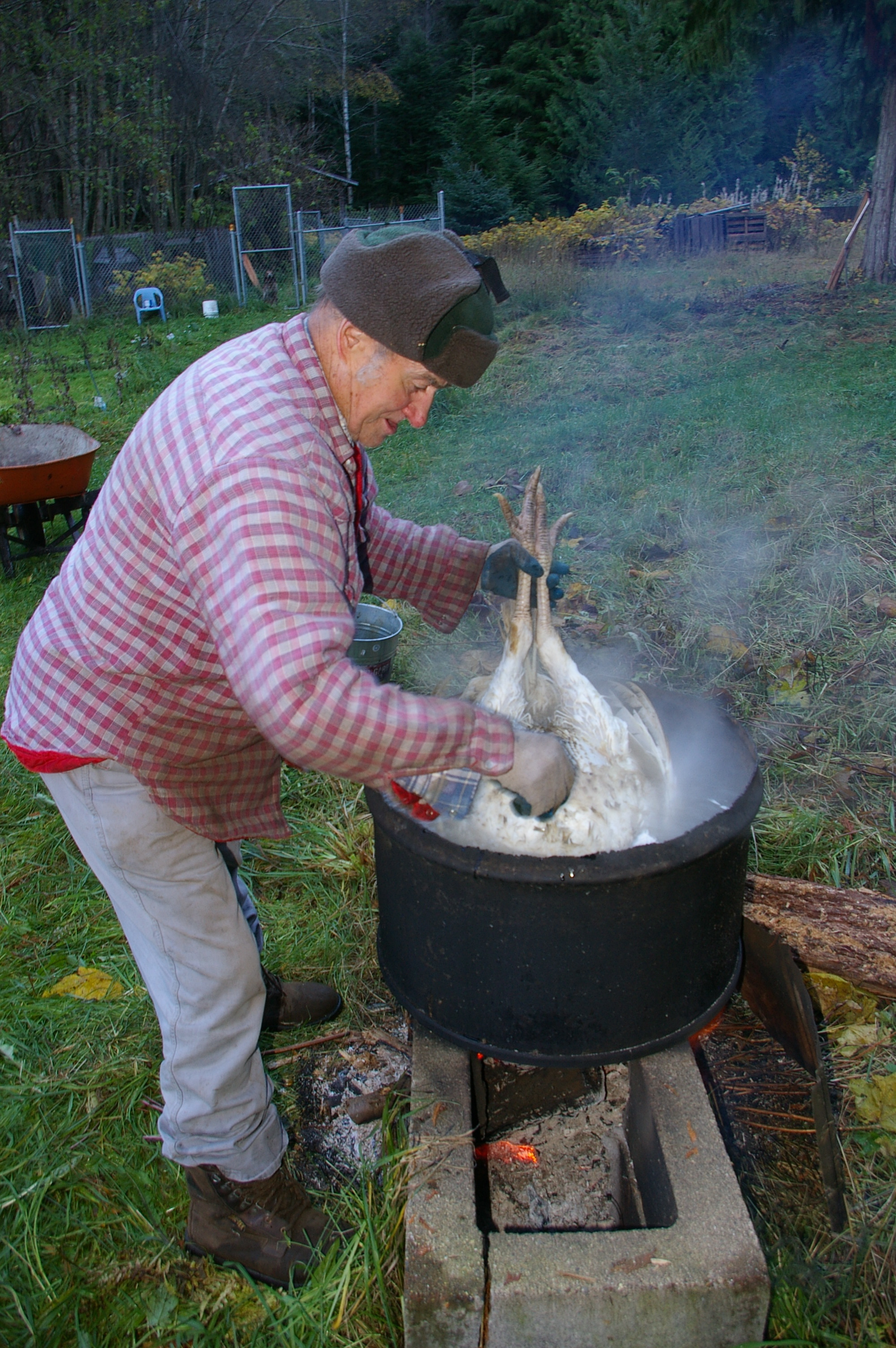
Dunking the Tom in hot water to make the feather plucking easier.
Step four: remove the feathers and the pin-feathers (re-dunk the bird if the feathers do not come off easily).

Let the plucking begin.

De-feathering, a close-up shot.
Step five: Remove the head and neck. To do this, you want to cut the skin around the neck and pull the beard back over the head. Then, find the aorta and windpipe, get your fingers under them. Then, cut into the chest wall, careful not to rupture the stomach and spill the content. Cut through the layers of skin, and then rip the fat with your hands, pulling it gently away from the stomach which will be located behind a wall of fat. Once you have located the stomach, pull gently on it and get it out of the chest cavity. Then hold the aorta and wind-pipe and and cut them off as deep into the chest as you can get. Then, peel it all back over the head, turn the head gently to find the joint where it attaches to the neck and cut between the head and neck joint. This will sever the head without having to cut through bone.

Cut skin all the way around the neck, below the beard in case of a Tom.

Locating the wind-pipe and aorta.
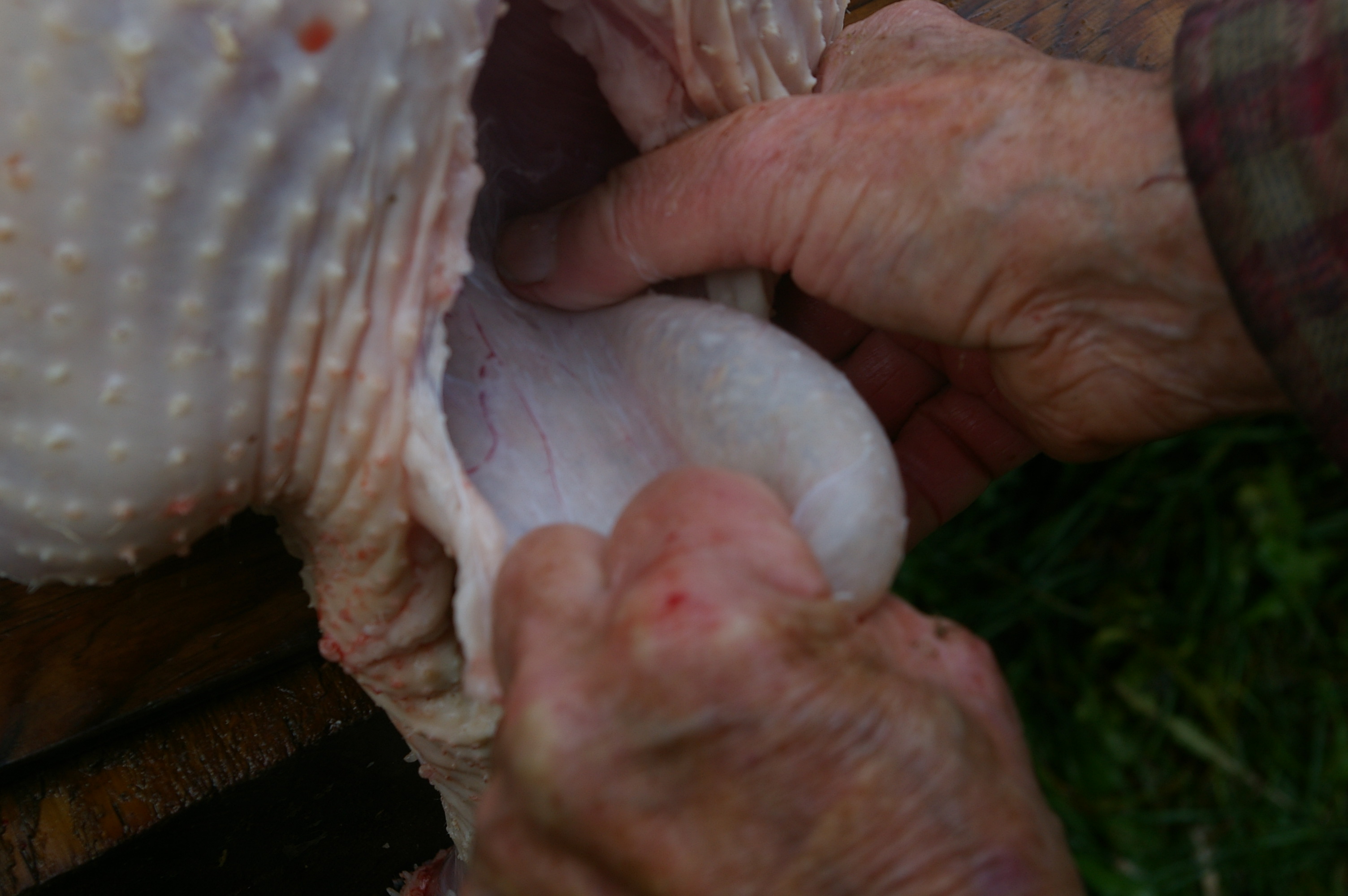
Gently pull stomach away from chest wall and out towards head.

Stomach being pulled out of chest cavity.

Sever head (and stomach, wind-pipe, aorta) from the neck at the joint where the head meets the neck.

Wind-pipe, aorta, stomach and neck off the bird.

Cutting off the neck.
Step six: Remove the lower legs. To do this, cut between the joint and sever the cartilage. This way, you don’t cut through any bone and the leg comes away easily.

Cut between the joint, through the cartiledge and sever the lower leg.
Within minutes of his death, the Tom begins to look a lot like Thanksgiving dinner.
Step seven: remove the oil sac. At the base of the bird, just above the tail is the oil sac. It is under the skin. Cut the skin, and gently pull away the skin and the oil sac as you go.

At the base of the tail is the oil sac, remove this first.
Step eight: remove the anus, being careful not to cut through the colon. To do this, cut the skin on either side of and around the anus. At this point, Clarence tells me that it comes in handy not having his left thumb and index finger tip, ‘I can use it to remove the stomach contents and not worry about my nails rupturing the contents!’ Incidentally, he did not lose them to the butchering process, but to a dynamite mishap as a young child.

Cutting around the anus, careful not to sever the colon and spill its contents.

Anus removed and colon tube exposed.
Step nine: Remove the innards. To do this, reach into the cavity with your hand. Roll your hand to one side, detaching the innards from the chest wall. Repeat towards the other direction. You should then be able to feel the heart and lungs. Take hold of these and gently pull your hand out from the belly cavity, pulling the contents with you.

Carefully removing the innards from the turkey.
Step ten: Once the innards have been removed, carefully cut out the heart, liver, and gizzard. Slice the heart in half (butterfly) and rinse of blood. Cut the liver away from the gall, careful not to spill the gall bladder contents, rinse. Cut the gizzard away and then carefully butterfly the meat, being sure not to cut into the crop and spill the contents, rinse. Put these items to one side with the neck. These pieces are kept for cooking and are cut up small and used to make the stuffing.

Carefully cut through meat surrounding the gizzard.

Behind the meat is the gizzard, a small pouch-like stomach full of grinding stones and undigested feed.

Carefully cut the liver away from the gall bladder, then rinse it clean.

Neck in two pieces, liver between neck, then heart, and gizzard.
Step ten: cool the bird. Place the bird in cool water to chill the meat completely and give it a final rinsing.

The final dunk, cooling the meat.
Finally, you have your turkey ready for the table or the freezer!

Three Tom turkeys now ready for the table.



 Howling Duck Ranch
Great post. A couple years ago when I was contemplating processing my own chickens, a could find nary a picture. Now they are everywhere, thanks to the magic of blogs!
Thanks for the pictorial.
I keep the esophagus intact with the rest of the alimentary canal, reaching through the body cavity and hooking my finger around it through the hole at the neck, and take EVERYTHING out through the back, throat to anus, all at the same time. No loose pipe in the body cavity at all that way. Joel Salitin sp? has a good youtube video of this method.
Very good job on this. This isn’t meant to be fun, it is just something you need to do.
I’m going to pass this along on a small town forum where they’re looking for info on slaughtering and butchering. Great info!
Very informative. But what about spilling all that blood- don’t you have bears around?
EJ-yes, good point you raise about the bears.
Here at HDR, we take care to catch it in a bucket and bury it deep in the garden. We take all the unusable innards and compost and/or burn them. Also, the bears are now beginning to move higher up in the alpine following the food. Another point to our butchering later in the year; fewer bears around.
Clarence has cats that get free access to it (the blood and certain innards, like the lungs and kidneys).
Others let the eagles and ravens take it all away. The stuff doesn’t sit here long, there are tonnes of anxious winged scavengers who make swift use of it.
YOUR A FU**ING SICK ASS MAN. IF THIS HAPPENED TO PEOPLE, DO YOU KNOW HOW FU**ED UP THE WORLD WOULD BE? ITS PEOPLE LIKE YOU WHO ARE RUINING EVERYTHING FOR THE PLANET AND ALL OF MAN KIND. DIE ALREADY OLD FAG.
Kenzie,
What did you eat for dinner and how do you suppose it died?
Keep it clean if you want me to keep posting your comments.
the bad language again, makes an argument pointless and meaningless.
Howling duck looks like you have now been truly annotated into the ‘bad person’ catergory…welcome!
Welcome to the world of sausage trees, turkey breast bushes and vegetarian wild carion birds!
You have arrived!!!
Thank you for the acceptance into “The Club!” Lol.
Thanks for the info I will try this method out this weekend!!
A little philosophy for the nay sayers that find it necessary inflict there beliefs on us!
Q:Do you know the difference between a meat eater and a vegan?
A:Meat eaters don’t care whether you eat meat or not
PS-the turkey I am butchering this weekend got into the fence and is injured!
This is exactly the way I dispatch my chickens, mostly roosters as I keep the hens for eggs. However, I did learn more here on exactly to locate the juggler as I always have a little trouble with that. Now I will be more confident that I am doing it correctly and am being kinder to the bird. Most people would rather get their meat at the grocer’s counter, never having to consider even for a small moment what horrors that bird might have gone through to get there. The lives of birds at most poultry farms is a misery from birth to death. Then there are the vegetarians that never consider how many cute little bunny rabbits and field mice would be shredded in farm machinery should we all commit to a meatless grain and greens diet. My boyfriend likes to say that my birds have only about two minutes of a bad life. The rest is a happy, green, free-ranging life here living just the way chickens are supposed to live. Thanks for putting out this great information.
I agree. What most people don’t understand is that homesteaders or those who raise their own meat generally have a great respect for those animal and they are treated more humanly than those raised in feedlots and butchered at slaughter houses.
Sadly they are probably a member of a group like PETA, where it’s ok to euthanize animals, just not to eat them.
HDR thanks for the refresher. I use pretty much the same method, except I use a cone to prevent too much wing flapping. The Cone synthesizes when I hold them under my arm and cover their head…they just quietly go to sleep. I appreciate the refresher as its been about three years and I needed to verify my brain remembered…..
To Jennifer~ I love PETA, (People Eating Tasty Animals) ….Just call that one above ignorant. I believe that raising our animals in a caring, healthy and safe environment, then removing them in a loving way (not on the transport van into a dirty crowded facility) not suffering at any time during the process , is the best way to show kindness to the foods we eat. I feel sorry for those who dont eat meat, I heard that “plants feel pain too”.
Have another drink looser,The man is slaughtering a bird not a baby,how do you think it was done IDIOT
added this site to my favorites. Will be processing two turkeys soon & wasn’t sure how. This is going to be a HUGE help! Humane,very clear & step by step. Thanks!!!
Hey Andy,
You know, I too had to refer to my own site! When I came to do it myself on my own a few days after learning. It’s a lot to remember for a newbie. Glad you find it helpful.
cheers,
Kristeva
you do realize moron that what this sick old fart is doing to the turkey (a defenseless animal just like a baby) is just prep work for doing it to humans, yes babies too. the sooner this guy dies the better. our society is not safe with humans behaving this way.
You’re so right Shel. I never even thought of it! After turkey today we’ll have our 3 month old baby for dessert. Good idea. Before I waste my day ranting about the positive benefits for people and the world of naturally raised meat, I’ll just share this.
http://www.mattcutts.com/blog/something-is-wrong-on-the-internet/
You are an idiot. First, unless you did not grow incisors, you were meant to be an omnivore, that means you eat meat. This is a humane way to butcher the animal and prepare it for cooking. Not to mention raising your own animals makes it even more humane than the animal factories. Are you a strict vegetarian? If so, why are you even reading this article? And since you obviously have never raised your own poultry, let me tell you that they are not defenseless, and they are sometimes cannabalistic. So don’t go spouting innocence and babies. There is no comparison. So go back to your self-induced stupidity and play a video game.
Um, this has been going on for tens of thousands of years, and yet people still have not resorted to the awfulness you speak of. Imagine that….
I totally agree with you Shel! This man is a looser, a potential killer. A coward…looking for attention, what a shame!
DO YOU EAT MEAT <FISH <EGGS OR ANY VEGETABLE PROTEIN?
These birds probally had the best of everthing,but were raised for food,the food you eat have had horrible lives,crampted or no space never put foot on soil .THEN THEY WERE INHUMANILY SLAUGHTERED AND OBIVESLY YOU GOT THEIR ANGER AND STUPIDITY BY EATING STORE BOUGHT MEAT.
Shel so as I asked “Kenzie” have you ever ate meat of any kind ?
or worn leather, shoes included lol or use cosmetics ?
if not.. god bless your husband lol roflmbo 🙂
and Maria Moony.. enjoy your tofu burger tomorrow !
and when the grid goes down RIP 😉
I was just wondering if your for paned parenthood and the murdering of innocent unborn children I found most animal activist are for the murdering of children
And I’ve noticed there are a lot of holier than thou folks like yourself trolling the internet looking for senseless arguments. Look elsewhere Bobby.
Kenzie, You sound like a young fool, How would you go about feeding your family if you did not have money or a grocery store where you just go out and buy your food? Just how do you think people got along say 150 yrs ago?? Yes a person can now days live off of vegies but no so much a few decades ago you had eat what you could grow, gather and hunt for.
I feel that probably live off the work of others! you are very quick to say such foolish things!!!
SERIOUSLY?
how do you think you get fed?
Wow, learn to love silly Kenzie. It’s actually people like ‘YOU’ that are screwing things up. Buying all their food at a supermarket not knowing where it came from what it was fed. The last thing you ate if you not a vegetarian or vegan was raised in a small cage barely big enough for it to stand up. If it helps you sleep at night knowing that you didn’t have to kill what you eat, so be it, there are a lot of ignorant people out there. Do you eat meat? If you do your hypocritical. Your killing an animal everytime you eat meat from a store. The difference is, Mine lived a good free range life where as yours lived in a box. Learn.
your a dip shit
That comment was for kezie
LOL, thanks for the clarification Matt.
I take it you’ve never ate meat or fish of any kind ?
also you don’t wear leather or cosmetics ?
one more thing.. there are times coming very soon where food will be scarce and this tutorial will come in handy for those who hunt and would like to eat and survive ! sad to think that you will perish !
Happy Thanksgiving ! LOL 🙂
eat some rice and grass god bless you and your freedom to chose gods will gods way
These anamals are sure treated a lot better than abortion doctors treat babys, or isis treat their victims. Be vagan if you want but learn to apriciate respect when you see it. Live and let live. Why did you even look at this if you had no intention of humainly slaughtering turkeys?
Peace
Great pictorial, we do our’s like Joel and Clarence. The only difference is we tuck the legs for our customers, so the turkeys fit in the roaster better.
Great pictures – glad you had great weather, it sure makes a difference.
We ended up with a high percentage of toms this year, I’m hoping they don’t begin to fight before the big day.
Fantastic post. I just can’t get enough of good information from the experience of folks doing what they do.
So glad that you came by our blog…
peace
Great post. Thanks for the pictures.
Grammy
Trapper–the birds are just cooling at the moment, we later tied them, wrapped them, and weighed them. Also the giblets went into a ziplock bag inside the birds, ‘just like the grocery store does’.
Pingback: Notice: More details added to turkey butchering post. « Howling Duck Ranch
The leg tucking I was talking about, just involves an additional slice in the skin near the butt, and then the legs are tucked through a what it a hole basically in the skin while the carcass is still warm and before cooling.
I’ll post about our procedure when we do our turkeys.
Could you tell me where to make my slice to tuck them in. Please my chicken legs were straight up after i butchered them lol 🙂
Thanks for this web site it was very helpful.
When in doubt, use butcher string and tie them down for roasting! I don’t make a slice anywhere except where I take their innards out.
Kristeva
that Turkey was a mother’s baby. How would you feel if some one did this to your baby? grow a brain that has some goddamned empathy. humans do not need to eat Turkeys…in fact, eating dead bodies causes degenerative health problems. do not harm others. do not hurt others, do not kill others….unless you want this done to you. duh
oh, duh, so was the rattlesnake we killed. boo hoo Poultry is a good protein source. And again, since you obviously never raised your own poultry (your mother was severely lacking in your own education, wasn’t she?) they often kill their own babies. lol Competition and survival of the fittest – nature’s way of chlorinating the gene pool. Too bad there is no natural method of chlorinating the human gene pool.
Really? Tell that to lions and other animals. They start ripping them apart while they are still alive, WITHOUT apologizing to their mothers. The bastards.
for crying out loud!!! Are you for real?? It was God who slaughtered the first animals in order to provide a covering for mans nakedness. It was also God who instructed man to eat the animals for sustenance with explicit instructions on how. Go save a rock or something….even they will cry out one day!
Shel, go away….
Go visit an actual small family farm where the animals are treated humanely, and don’t believe that all farms are like the factory farms. Or continue to be ignorant and believe the crap that organizations like PETA throws out there. Here is a great article that shows how people like you choose to live in a bubble and think that you know everything and refuse to take the opportunity to learn. http://farmgirlsfight.blogspot.com/2014/02/to-man-who-knows-me-better-than-i-know.html
The next time I butcher a chicken or a turkey I’ll be thinking of mindless Hippocrates like you. Of course your meat would be far to bitter to eat.
(that last sentence should not be taken literally) But here is a paradox, I don’t believe in HELL but that’s where I want you to burn.
Your mother should have swallowed you. Now shut up and go away.
Trapper–when you do, perhaps you can ‘ping’ this post to your post.
Good idea HDR, and I keep forgetting to say Clarence is a treasure, and love the finger shots, my dad was an adventuresome lad himself and lost the tips of his fingers playing with blasting caps, at the age of five. It was a 5 mile horseback trip to the milltown where there was a doctor in residence. Our neighbor also was missing fingers , and for the longest time when I was little, I assumed everyone’s Dad was missing some part of their fingers. 🙂
Clarence is a treasure–I consider him to be my ‘hand picked’ or ‘chosen’ grandpa (a term I learned from his son when he was describing a good friend as his ‘chosen’ brother).
One of my grandpas was missing a finger too, it was to a motorcycle chain!
I think this is actually pretty cool. I’m always learning new things about this stuff. I would like to have a farm of my own one day and your website is cool. Must of took lots of time and patience to do.
Well thanks for making it–bye.
Great post –
& brave of you too, I know you’ve seen the wrangles Stoney’s had with the “Animal Rights” brigade over the way he chooses to live (ethically, & responsibly IMHO).
I’ve found this description really interesting & will suggest we give it a ‘go’ ourselves, when preparing our goose for Christmas Dinner (we usually tackle a traditional medieval mulit-bird roast with goose, capon, wild mallard & grouse).
Our own method is to calm & then hold the bird still after which we shoot him in the head, being the swiftest, most painless method we’ve found so far at least, in lieu of a large enough humane despatcher.
However we found the plucking process tricky as we didn’t have access to hot water & had to start a record-time plucking to render the gander naked! And removing the feet was, err, entertaining….. putting the feet in the door jamb & closing it, then pulling like crazy in a sort-of bizarre tug-o’-war – but it works, this method is especially effective for removing the tough leg sinews.
Incidentally don’t be tempted to do any of the above, on a breezy day – otherwise you end up looking like Frosty the Snowman & by the time you’ve finished, will have your own makeshift pillow/duvet, will sneeze for weeks afterwards & still be picking tiny, irritating feathers from each & every orifice from here until next Thanksgiving!
Thank you so much! This was very informative. I’m just reading theory of all this at the moment but seeing clear, color pictures of things like this is very helpful. Many homesteading books only have drawings and it’s impossible to understand anatomy in all its gory details from them.
Not sure yet if I could do this in real life, but I’m definitely not eating turkey or chicken as long as I’m unable to bear the full responsibility of my choices. If you can’t kill it, you can’t eat it. Anyways, thanks for showing this. I wish people would understand that no matter how “awful” it looks, the birds in the industrial butcheries go through much worse treatment!
Em-thanks for the feedback! Yours is exactly the response I was hoping for–to be helpful to someone who was struggling like I was. I know how difficult it was for me to find good info on this stuff too and why I decided to do the ‘gory’ post.
I encourage you to try the butchering process. It is not easy at first, but once you get a few birds under your belt, I assure you that you will feel good about it and much more at ease with the whole process. I can say this with confidence because of my own emotional trajectory in the past few years, and especially since the hands-on lessons with Clarence.
In addition, I can see that you will do fine simply by reading through your thought process about it all–very similar to mine. You are on the right track!
Let me know how you go when you ‘pluck’ up the courage, I’ll be interested to know.
yes, exactly. killing becomes easier the more you do it just like in Vietnam and in times of war. Especially when you kill for pleasure as in the case of killing a turkey for a stupid meal to a bunch of diseased psychotic fat asses. it will make you a great serial killer one day, ready to kill babies and children just as defenseless and unsuspecting as these animals.
Oh Shel….just for you I’m going to butcher a few turkeys and chickens tonight (one for each of your idiotic comments) 😉 Keep your comments coming…I’m hungry!
Shel your just being fesitious right? No one is really that stupid ? I mean nobody actually likens the butchering of animals to humans?
Well said Shel!
You are exactly right Shel. I know that the more VC that I killed, the easier it got, but the whole thing with the VC, they were such runty little guys that to get enough of them to make a good meal, you had to kill so many of them that you would get worn out. Kinda like quail, there was just not much meat on ’em. So we would usually just open up some “C” rations to make them stretch, ‘ya know? You are wrong about one thing though, since I got home, I have not had the slightest craving to kill any women or children. Could there be something wrong with me? I do confess that occasionally I will get a craving for a nice, plump vegan, but they are very greasy and they give me heartburn.
Great post.
What strikes me most about it is the fact that you felt the need to put up “graphic post” warnings. Granted it’s true, but it’s a sad indictment at how far removed so many of us have become from how we get our food. People are so used to going to a store and getting plastic wrapped food that they don’t realize that an animal actually gave its life to feed them– and that’s sad. But there is hope. I think people are finally waking up to the truth in food.
Jen–how true it is (that people are very removed from the origins of their food). For example, when I was vegetarian, the most common response was: You mean you don’t even eat chicken, or ham?
If you would like to see what fellow ‘Conscious Conscientious Farmers’ blogger have put up with (and know why I put up the warnings I did), please see: Stonehead ‘How to skin a rabbit’ and the comments that he’s gotten for that post (which is not nearly as graphic as mine)!
Pingback: Turkey processing time « Throwback at Trapper Creek
This is great info, I’m going to kill my first on Monday or Tuesday just in case I slip up I’ll have time for a store bought. I love the step by step. One thing you didn’t mention is the removal of the lungs, I’ve read they can be difficult??
Wish me luck.
Thanks you so much.
Very clear and easy to follow. I could not have asked for a better path.
Very well written and illustrated post. While I don’t kill and butcher my own, I’m not so far removed as to not know where it came from.
My father told a story from when he was a kid ion the 20’s and 30’s of how they”d butchered a cow. The cousins said “We ain’t eatin’ that ol’ dead cow!”
So my grandfather took said old cow into to town and the town butcher wrapped it for him.
Cousins thought that was the best beef they’d had 😉
Ventured to Stonehead’s Rabbit post. Bunch of idiots that posted there. You might have missed on them because as one of Stonehead’s posters mentioned, Turkeys “aren’t cute fuzzy bunnies.”
Happy T-Day 🙂
Pingback: Poultry in motion « Howling Duck Ranch
Jeff–nice story about the cousins! As for the turkey comment not being ute, fuzzy bunnie’ is said by people who have not raised turkeys– I find them wonderful, charming, curious and intelligent creatures. In fact, mine tend to like to join us for morning coffee on the porch.
of course… you may as well be cutting your dogs throat!
If you’re new to this, remember to remove feed & water from your birds: the evening before, if you’re going to butcher early in the morning. And the very FIRST thing you mus learn is how to sharpen a knife!
It’s better to leave them water, they bleed out easier and taste better.
Throw a few bags of Ice in the water helps to absorb some water.
Leave them in there for about an hour.
The Turkey will not be as dry.
Wow – great post. It was hard to look at a few pictures, but I felt like it really helps us understand how spoiled we are in our grocery store culture.
I have recently made the decision to move to buying all our meat from small-scale free run organic farms, partly for health but mostly because I could never give up meat and yet also couldn’t reconcile myself to being complicit in the suffering of animals. It is more expensive and a little more inconvenient, but I wish we could help more people understand how important it is to do so.
I think it’s terribly sad that three generations of people now are so far removed from from our food sources that we forget the tremendous effort and cost involved in raising an animal for food. How can anyone in their right mind believe that you can hatch, raise, and feed a chicken for months, then slaughter, clean, pluck, package, and transport it, all for $6 – and still have profit left over? We have lost all perspective on what good food should actually cost, and our competitive consumerism has allowed us to turn a blind eye to practices that responsible farmers and hunters alike would never, ever condone. The animal rights activists often point a finger at are the ones who are working tirelessly towards a reasonable solution – require an appropriate investment and effort for the luxury of meat.
Thank you for showing that you have to know about your animals and how they are raised, and that involves the slaughter process. Jamie Oliver came up against the same issue when he televised a lamb slaughter – if you can’t bear the thought of the couple of seconds of fear or pain in the slaughter process, how can we bear the idea that the animals suffer for months in battery farms? Ridiculous. Thanks for showing the truth and making these folks face their own hypocrisy.
Hey! This is totally cruil!! You are killing a bird for no reason! We are humans!! WE DONT KILL LIKE THIS TO EAT, WE’RE SMART ENOUGH TO FIND ALTERNATIVES!! – IF OUT IN THE WILD TAKE FOOD WITH YOU!!!
IF THERE’S A HELL, YOU’RE GOING STRAIGHT TO IT!
where i live vegetables do not grow for over 6 months of the year whereas meat locally and humanely raised is readily available. i think i have a smaller impact on the overall environment by eating meat that has never travelled more than 200 miles throughout the winter. also at over 7000 feet many humans do not do well as vegetarians.
that’s why you have grocery stores! oh and there’s this neat thing you can do called canning and storage of things like potatoes. for centuries they been doing it ..WOW!
YES the vegan diet is healthy for all humans:
It is the position of the American Dietetic Association that appropriately planned vegetarian diets, including total vegetarian or vegan diets, are healthful, nutritionally adequate, and may provide health benefits in the prevention and treatment of certain diseases. Well-planned vegetarian diets are appropriate for individuals during all stages of the life cycle, including pregnancy, lactation, infancy, childhood, and adolescence, and for athletes.
http://www.eatright.org/about/content.aspx?id=8357
so this fat pschyo here killing animals is not doing it for any need…he just likes to kill. maybe it will be a cat or dog next…maybe a baby.
I am not fat, psychotic, or male. I am a city born and raised conscientious well educated human being. Perhaps you should get a bit more educated and be a little less of a knee-jerk reactionary, and re-join the conversation at a later date once you are up to speed about the issues at hand (instead of just proselytizing your opinions).
cheers,
Kristeva
I agree totally!!! it is very very barbaric and soooo cruel……unlike many I will not be eating the traditional thanksgiving dinner – thanks to who or what, certainly not those poor birds being held down and KILLED!!! Go to H….all of you who contribute to this!~!!!!!
Um… Shel, oh hell never mind you can’t fix stupid. Enjoy your vegan lifestyle but I suggest you learn tolerance for the majority of us that since the dawn of humans have ate meat.
FYI: you can pressure can turkey as well!! Tastes really good in the winter. I add fresh herbs, garlic, brown rice, and some veggies to the jars before adding the turkey and broth. Ready cooked meals in a jar 🙂 Great for work, emergency situations, or every day! And Shel, I have a friend who is an animal rights activist: she is vegan, works with several animal rescue groups, and has helped shut some (deserving) butcher shops down. The difference between her and you? She accepts that I have a right to my way of life, just as I do her. And neither of us tries to condemn or ridicule the other for their way of life. Why don’t you follow her lead?
It is not cruel. The fact is that we eat meat. I could say that plants have feelings too and that picking lettuce out of your garden hurts them. I don’t live out in the wild the wild lives with me. The fact is WE DO KILL LIKE THIS TO EAT! This has been going on for centuries. Look in your Bible even Jesus ate meat and yes someone had to kill it. Jesus fed a large crowd of people with fish. The fish had to die first before they could be eaten. The fish had to be gutted as well. So no…we are not going to Hell….
It would also appear I Roycroft is not smart enough to know how to spell though!
It’s ‘cruel’ not ‘cruil’
I could have more empathy with these people if they actually made reasonable, non volatile and confrontational postings.
I also wonder just how they think food reaches the super market. Was a magic wand waved and hey presto there is fully gutted turkey in the chiller cabinet?
Congratulations on getting your first raving comment from an animal liberation nutter. Of course, once you have one, you’ll soon find yourself with a whole flock cackling away at your heels and occasionally leaping up in a desperate bid to peck out your eyes.
How dare you I Roycraft!
It’s not cruel. My dear friends from Howling Duck Ranch are doing this in the most humane way possible.
Not everybody has needles to inject animals with (besides, you can’t do that if you are going to eat them!)
Great POST by the way, I love it. I’m planning to butcher about 5 roosters in the upcoming weeks so we will see how that goes…. Hmm…….
Cheers
Mitch
wow…”humane” and “kill”….used together. i believe you’ve created an oxymoron.
What a sheltered, unreal life you must lead to believe in most of what you’ve written. And yes, there is a humane way of killing. Unlike, the natural world where animals are killed, eaten alive by other animals, we as humans have the ability to kill quickly, efficiently, and with mercy.
C’mon guys Shel is a tool that is pulling your chain. It looks like he just
C’mon Guys, Shel is just pulling yous alls chain he
likes to see your responses and he’s getting what he’s after. Perhaps when a “non-productive” like Shel attempts to bait you, rather than respond you like minded self -sufficient learners would NOT respond AT ALL , you’ll all know by your lack of responses what you’re all doing. He’ll wither and go away from the lack of attention… like a child. Just say’n’,
Cheers, and I enjoy your adventures.
Bruce
thanks Bruce
Pretty sure Shel was just trolling because it was Thanksgiving and without eating meat, had no plans…
I personally found this whole article fascinating. I currently do not have the ability to raise my own animals, but will in the future. When that possibility is available to me, I will do so. I know my treatment of them will be much kinder than the factory animals.
I intend on butchering my own meat. I figure that if I can do it, I should. Every life is precious. Every animal that dies for my dinner is mourned and thanked for its sacrifice. If I can spare my dinner the torture of being farmed in a large building with millions of others, I would like to. Often the conditions are terrible. However I would not stop eating meat because I feel bad for something dying for me to eat. Plants are alive as well. So something dies no matter what. And the old adage of “Plants don’t feel pain” is bull. There are studies that prove that some plants do feel. They just feel in ways we cannot understand.
I figure I will find out how badly I want to eat meat when I do butcher my first turkey (poultry). It will go one of two ways. 1) I will feel bad for causing the end of the animal and mourn it long enough to thank it for giving me life. And I will be able to do it. or 2) I will find out in a hurry I have no desire to slaughter my own animals and will eat much less meat, possibly none. But either way I see no reason to begrudge anyone that disagrees with me.
Thanks for posting, like several years ago. lol
Wonderful post! We did our first Turkeys this last fall, and I wish we had read your post first. My dad and I were just about beaten to death by the big tom (43# dressed out for the oven) as we were “killing & bleeding” him. With a new baby due this spring (our own, human that is) we are scaling way back on what projects we start. Small garden, bees if they make it, no new critters or projects…
I found you through “meat” Ebey Island Farm.
Hello Photobby,
Thanks for sharing! Love that you had to clarify about the baby. lol… Keep farming. You’re kids will love and thank you for it in the future. Of that I’m certain.
Kristeva
WOW, those are some good looking birds! they are so fat and happy! Very well done, clear instructions and very good photos! Thanks
Pingback: Butchering chickens « Howling Duck Ranch
Inspiring, informative and a fact of life. Thank you.
To begin with I must congratulate you on putting up this most informative post. It is truly amazing, however I do have one question for you: why do you slit the jugular as opposed to merely beheading them? Is it just for the accuracy? So you don’t cut too low with an axe? And while I’m already at it, I have something that foes for both the rabbit post and here. People that don’t like to see things like this and don’t have positive feedback please keep your wits about you and come up with an intellegent argument. If the method of slaughter bothers you, say so clearly, and present an alternative. And although it feels strange to be asking this at fifteen years old, please do said steps in CLEAR INTELLIGIBLE ENGLISH. Lastly to end my rant, if you have not seen a pack of wolves take down a moose, and heard its squeals of terror while attempting to defend two young calves who are slaughtered before her, only for the mother to be eaten from the rear up while still alive, the wolves going blood drunk, and tearing out her anus, intestines, and other inner organs, while she moans with pain beyond any of our imagining… Please keep your feeble arguments to yourself. Don’t forget that a potato has every single vitamin in it necessary for us to live. Kenzie and I Roycroft, would you like them baked, or mashed? Butter? Hell no, that comes from animals and is not necessary for you to live…. Good day.
Josef
I don’t cut their heads off for a couple of reasons: one, the heart soon stops bleeding and as a consequence, they don’t bleed out completely, and two, the birds flop around far too much when you cut their heads off which can bruise the flesh (it is true what they say about running around like a chicken with its head cut off!). I find the kosher way of cutting just the jugular a far superior and more human way of dispatching them. They lie still while bleeding out and only have their last little flap as they gasp their last breath. This final flap also helps push the last of the blood from their system which leaves the meat really clean.
cheers,
HDR
Josef, young man, you need to write a book and put this wolf passage in it. I was both disgusted and amazed! Good point.~~~Ana
wow Josef, you mean to say you are a wolf and need a wolve’s diet?
wolf’s….
Thank you for the great info. I just finished butchering six chickens and I wish that I would have found your information before I started them. I used to help my father when I was young on the farm but I never paid much attention as I wished I would have now. They came out fine but it seems like it took me for ever. I, as many that didn’t know your way, chopped their heads off with an axe. I have four turkeys to do soon. I really want to thank you for all the pictures. It is really going to help. I also printed your whole procedure to have on hand when the time comes. This will be my first time ever doing turkeys. Can you tell me what the best age of a turkey is to butcher? I have no idea on when the best time is to butcher them. My father has passed and like I stated earlier I wish that I would have paid more attention. As for the people with the bad comments, they really need to learn that without folks like you helping teach others the proper way to do this job there would be a lot more suffering animals out there. I wounder what they are going to do if the day ever comes that they can’t go down to the local store and buy thier food. They will starve while we go to bed at night with full bellies. Thanks again
Hey Lance,
Yep, it’s for people like you (and me before I learned) who have had little or no experience that I made the post. When I first tried doing it I could only find a description in a book. Needless to say, the experience was miserable; both for me and the chicken! Glad you found it useful. Also, take a look at my chicken butchering page for the more updated way (first I knock the chickens/turkeys out before slitting their throats). It makes for an even more humane butchering process as they are unconscious when you cut them. But, their hearts are still beating and thus they drain their blood swiftly.
As for when I butcher my turkeys… it is more a weight thing than a date thing. I like to butcher them when they are about 16-25lbs. Most folks don’t want the huge turkeys any longer. Mine get to that weight in about 20-24 weeks or so. Some grow faster than others. The whites being the fastest growing, the males are bigger than the females. Do check back here and let me know how you go with them! I’ll be butchering mine the first week of October for our Thanksgiving.
cheers,
HDR
Good evening!!
Thanks for the great information. We just finished processing 4 turkeys…2 toms and 2 hens. They were day olds on June 1st..so just a little over 4 months old. Our biggest Tom was 25lbs…and the smallest hen was about 18…
We had a nice cool October day. I was so glad to find your pictures because I was wondering how I could boil enough water to scald them for plucking…but the 55 gallon drum cut in two over a nice big fire worked great. We just kept adding cold water to keep the temperature down. We did find that if the water gets too hot, or if you leave them in there to long…that’s not good:)
We are going to roast one on Wednesday evening for dinner…I will try to remember to let you know how they tasted.
Regards,
Jason
Glad to be of help! Sounds like you had good feed and healthy birds. Yes, the 55 gallon drum over a fire works but you do have to be diligent with it. It does make a nice, simple, ‘back in the day’ kind of feel for the whole processing piece though doesn’t it. I do hope you drop back in to let me know how they tasted. I’m sure they’ll be the best you’ve ever had (if you’ve not done this before). I know mine are fantastic. Incidentally, what else are you raising?
cheers,
HDR
Thank you for posting this, i have extra roosters, may be i can fill my freezer with them, just could figure out how to do it, hopefully this post would help me to get start.
Great photos ! I always have had problems with stomach. This might help with the 10 I have to do next week. My father in law taught me, he raised turkeys on their ranch while growing up. One thing extra he added to before cutting the jugglars was to poke your knife up into the mouth and into the brain for the kill. Also we would take an old material or woven feed sack and cut a whole in the bottom corner and stick the birds head through it and then wrap the rest of the sack around it to keep them from flopping until their competely dead and the blood has drained.
Hello Tony,
Thanks for the additional info on how you folks do it — the feed sack is a great idea. Because mine hang from the trees while dying, they don’t damage themselves by flopping all over the place. In fact, they don’t flap at all except for the ‘last gasp’ as it were.
PS. you may also wish to look at my chicken butchering page. I knock them unconscious before slitting their throats which not only is more humane but also the flopping becomes a non-issue.
You can take an extra large road cone and cut the bottom of it off and put the turkey in it with the neck extending out. It the cone is large enough the part you cut off would be the right size for a chicken as well. You can nail or screw them into a tree or a frame with fender washers to keep the screws from pulling through the rubber. It keeps them from flapping all together. It also keeps them calm so they don’t release ‘fear’ chemicals into the meat, which you would in turn eat and is unhealthy.
i loved this info. this year was my first time helping butcher turkeys (25!!!) with my neighbors and i wish i had had this info then. many many thanks for posting with clear pictures. next year we will do it this way.
i am glad people are willing to share this kind of information as these are skills that could so easily be lost. i think these skills are a huge part of local food sovereignty and will become more important as we have to move away from an oil based economy. thanks again!
you must be so proud! now you can kill all sorts of helpless animals!
Hello Shei,
I am proud. Very proud. It is not easy to do. To hand raise my own animals and then learn how to kill them was not easy. Not easy emotionally or physically. But, I like knowing where my food comes from, that it is not laden with antibiotics or sub-standard feed, that the animals had a good life until I dispatched them. If you buy eggs, milk, cheese, or tofu from the grocery store, you cannot say the same for your sustenance. Exactly, what do you eat? What do you clothe yourself with? Do you drive? Do you use a cell phone? Do you use electricity?
Are you really so naive to think that eating tofu, tempeh, or beans does not affect or kill animals? Do you know anything about the raising of beans, wheat, or grains? Have you any idea how many animals are killed by the harvesting of these items? Or the millions of acres of habitat that animals are directly displaced from in order for you to live a vegetarian/vegan lifestyle?
Grow up. Get educated. And, get over yourself.
Kristeva
Came to this site from your chicken butchering site, to see if there was a lot of difference.
No, the process is pretty much the same, as I find it to be in my own practice. Just more pulling to remove the crop. What does differ is the witness factor.
I butcher a whiterock chicken with about as much compunction as I pick a tomato, they are inbred to the point of idiocy, and, while they deserve the respect one accords to any living creature, their basic function is as a food source. Young roosters of a laying breed seem more intelligent and I thin them by “irritation factor”. “You’re beautiful,baby, but no one crows under my window at 3AM and lives.” Hens too old to lay are deemed to have earned their retirement.
Turkeys are yet another step. While chickens will cheerfully stand in line to catch bits of offal from their siblings, turkeys seem to be a little upset by the butchering of another one. “Hey! What’d she just do to Joe?” “Yeah, what was…oh, look at the junebug.” “Joe who?…Yummy, feathers.” So I remove the bird I’m killing from the other’s sight.
I don’t even want to talk about ducks. Know somebody wants a bunch of drakes? It was easier when I was a hunter. Tame ones have to really tick me off.
Mary Zeman, lake Arenal, Costa Rica
guys, you’re killers T.T How can you kill it and then eat it? Why they’re not eating us? KILLERS!!!>=(
Why do you have killing animals, when you have lots of another food without not killing animals? huh?
K-I-L-L-E-R-S-!-!-!
I’m a vegetarian, cuz I have some heart.
You guys, have NO HEART.
Killers.
I can tell you are very young, or atleast I hope you are based on your grammar usage. It’s good as a young person to be idealistic and want to change the world, but you need to direct it properly. These animals were, obviously, raised kindly and dispatched humanely. They lived natural, healthy lives. Not everyone is going to be a vegatarian. We were not created to be vegetarians. We do not have blunt teeth, as vegetarian animals do, our bodies are meant to have protein to survive. Vegans and vegetarians have to come up with ways to replace the protein that meat would otherwise supply. We are omnivores and it’s okay if you choose to fight nature, but don’t expect the majority too. If you want to rave at someone about the atrocities of farming there are plenty of folks who behave atrocious towards their animals that deserve it. I’d start with the big, commercial farms that have broilers caged in pens so small the birds can’t turn around in because any excersize would mean potential weight loss. Leave these folks alone…there are plenty of villains out there, but small, family farmers aren’t them.
oh boy here we go again….
It is the position of the American Dietetic Association that appropriately planned vegetarian diets, including total vegetarian or vegan diets, are healthful, nutritionally adequate, and may provide health benefits in the prevention and treatment of certain diseases. Well-planned vegetarian diets are appropriate for individuals during all stages of the life cycle, including pregnancy, lactation, infancy, childhood, and adolescence, and for athletes.
http://www.eatright.org/about/content.aspx?id=8357
so now you need to face the truth and own up to the fact that you don’t need to snuff out a life, you just want to.
Who cares what the American Dietetic Association has to say, they are just another government funded program to keep the people under government control. If you are so against the raising and butchering of our own food then why are you looking at a site having to do with killing of animals. All you are proving is that you are ignorant and quite content in living by what the government and so called experts have to say. Good for you but don’t try to tell those that know how to live what to do.
The truth is there has never been a human group that were vegan. Every human group since the dawn of time has relied on animals for its sustenance, its shelter, its clothing, its livelihood, even if vegetarian. I am thankful for the animals that provide me with the above.
cheers,
Kristeva
“Human Ancestors Were Nearly All Vegetarians” from Scientific American.
http://blogs.scientificamerican.com/guest-blog/2012/07/23/human-ancestors-were-nearly-all-vegetarians/
dear vegetarian,
As a person who is willing to take responsibility for the things that I eat and use, I ask if you do the same? I would wager that if i came to your home i could find any number of things that mean some animal suffered or lost it’s life to provide it for you.
If this is a case of loving the animals, realize that many of the domesticated animals of today are domesticated to provide food. Period. If we did not utilize them for their milk, meat or eggs, many of them simply would not be. These are not wild, undeveloped species. they were selected for their use. They are not a natural part of the species they came from.
The wood your home contains, furniture, building etc., that was all home or food for some creature.
Those “wild picked” berries in your freezer section of the market? those were food fro small animals and birds in the wild,before they were picked, frozen and shipped countless miles to get to your table.
That food you eat, unless you grow it yourself (Plant murderer) or know exactly where it comes from and how it is grown, does more damage to the environment than you are aware of. What IS the difference between killing an animal and killing a plant? Go ahead, you cannot make argument for one, (as how do we know plants do not feel or react when we kill them?), and not the other, and be considered any sort of ethical person.
We might not be able to measure or detect pain in plants, but why take any chances. You cannot eat the grain or seeds, those are the natural food for the wild animals, you will be starving them if you do! You may only drink water, but not too much, and you cannot filter or clean it first as you will be killing the microbes that live in it. Killing is killing. Learn that lesson, then you can talk to those of us that actually take that responsibility seriously.
Enjoy your day.
So you prefer extinction? There is no place left for wild cow, most forms of sheep and goat, almost all breeds of poultry would all go extinct without a need for them on farms. I prefer a quality, if short, purposeful life to complete extinction. Are you prepared to keep complete flocks as pets to prevent their obliteration from earth?
Thanks so much for the wonderful post! We’ll be doing our first butchering of chickens next week and I’ll be printing this out to refer to during the process. I hope we don’t run into any probs. Will let you know how it goes.
We are processing Black Turkeys. We have found that after defeathering there is still a black substance left where the feather was. Is that a normal thing? It really looks unappealling is there a way to avoid this. When you squeeze it the black stains the skin and your hands.
Hello Anne,
What you are talking about is the coloring where the feather inserts into the skin. Yes, it is quite normal. The ‘unappealing’ feeling you have is normal too! I had it at first also. It is just that we have become so accustomed to the white turkeys of corporate Ag. I have found that once the bird is cooked, the color is less obvious, and no big deal. In fact, you get so used to it that conventional white birds begin to look like they are lacking something!
Go forth and be brave. It is how food should be. Consider them like a wild bird and so much more nutritious. Who knows, the dark coloring (like berries) may be full of antioxidants. Enjoy!
Kristeva
How can you feel that this will ‘help’ anyone who cares about life, the world and all in it.
People who are behaving in this manner are not being human.
Savage, why eat an animal just to wipe your ass with the tree you allowed to be cut down.
I’m confused as to why vegetarians and animal activists are even visiting this website. Why would you be searching the web for slaughtering turkeys if you aren’t interested in doing it yourself? It seems they have nothing better to do then to inform others, in a childish manner, that we are evil for eating meat. Killing and eating an animal IS behaving as a human and has nothing to do with not caring about life. When a human kills a human, that is NOT caring about life. Putting animals above humans is NOT being human.
Anyways, to comment on what this website is intended for. A lot of websites describe how to slaughter a turkey but with no illustrations. I found the pictures to be very helpful. We have slaughtered chickens before but never a turkey and I was wanting to know the best way to do this. Thank you for taking the time to illustrate this.
If this were facebook I would LIKE your comment. I agree with every point you made.
thx was doing a report about turkeys helped alot thx again!
Great Blog very informative. Kosher butchering really works well. I was taught this in 1983 by a Jewish Rabbi and Butchered many chickens. It seemed like a more peaceful way for our food to stop breathing and less dramatic with no flopping and damage to the meat. About 15 minutes hang upside down works well. I used this as an assembly line and would do 10 chickens at a time. Great Post!
Pingback: Growing and preparing turkey for Thanksgiving | Garden Fowl
omg stupid vegetarians u think u would be here on earth today if your ancestors weren’t eating meat n killing animals ? U think that ur computer n f*ing life would be here if it wasn’t the meat of the dead animals n their meat and the world would be a better place ? you think that after you have told your self that you hate meat your body doesn’t need the protein u vegetarians are just like religious people or worst i guess.
Thank you so much for this information and the excellent photos. I’m about to start the first of my turkeys and really wasn’t sure of how to go about it. I live in Australia and there seems to be much fewer people here who raise them – well at least certainly in the area I live. What age range are turkeys generally eaten and how old is too old?
Hello Karen,
I generally raise them between 20-22 weeks because my client’s don’t want huge turkeys. At that age, they are generally between 16-24 lbs. You certainly can let them get older and heavier, it’s really up to your preference. I do know that beyond about 8 months old though they will begin to get tougher. They would still make find ground meat if you have the means to prepare that, but if you want roasters then keep them younger.
Good luck!
Kristeva
Hello Kristeva
Thank you for your reply above.
Oh my goodness…what a debacle it was doing my turkeys! Due to a back injury I asked for some assistance from some friends to come and help me with 4 turkeys, 3 ducks and 7 roosters. As the bloke doing the slaughtering was not familiar with using a knife to cut the jugular he elected to use the axe and chop off their heads, believing this would be less traumatic for the turkey – you know, quick and instant! Oh my goodness! The turkeys took ages – like several minutes – to stop their frantic wing flapping. After the first bird was killed we put the others inside a feed bag with just the corner cut off so the head and neck were exposed. This at least reduced the wing flapping and protected the meat but I doubt did little for the bird’s actual experience. Without a doubt I will be using the throat cutting next time. It must be a great shock to the birds nervous system when the head is chopped off for it to continue flapping like that rather than when the more subdued throat cut/bleeding method shown is used. A very confronting experience and one we can and will improve on next time – out of respect for the birds as much as anything else.
wow maybe we should throw you in a sack with your head sticking out and lop your head off. let’s see how much your arms flap around despite your crippled back. at least then you’ll know that it sucked really bad.
I want to start eating stupid people like shel then maybe the world wont be over crowded with jack asses
Hi i’m from Australia also actually the Top End, we have dispatched 3 turkeys. The first one was lovely and it was about 18 weeks old. The older two were over a year old. Still nice though but boy, how tired were my arms after plucking. The meat was not tough but firm to cut, drumsticks a little more so. What do you feed yours and how much? We found one of our turkeys had a large layer of fat, I think maybe overfed. Do you hang your tukeys,if so how long? Must say I have found this blog very interesting, helpful and entertaining. I can’t believe the idiocy of some of the bloggers,
Hi Deanie,
I fed mine corn and mixed grains. Found the actual pellets they sell the turkeys and chickens didn’t like. I think because they are made with soy and it goes rancid. I tested this theory by putting mixed grains on one side of my feeder and the pellets on the other. They all went for the fresh grains and ignored the pellets until they had no other option. I also let mine free range, a lot! They ranged daily and used the grains to supplement themselves.
I lived in Aussie for three months while attending ANU. Loved it! I still miss the smell of eucalyptus trees and the sound of the magpies (6 yrs in NZ).
cheers,
Kristeva
Great post! i will be going over this again soon. I will be butchering my cornish X chickens soon and then alot of birds toward the end of summer. Great reference here.
=)
This is really gruesome, but it is quite a skill you have. Most of us will eat turkey, but don’t want to think of how that turkey sandwich got to our plate. I’m sure this is much more humane than a factory-scale turkey slaughtering factory.
I ended up at your site because I bought a frozen duck, and was wanting to identify those strange little parts that came inside the duck. I googled, “duck heart liver gizzards, and clicked on a photo. Thanks! At now I know which piece would be the foie gras piece.
I just scrolled up through the comments and read some of the interesting debate. I’ve been vegetarian, vegan, and uhh. . .an omnivore, I guess you’d say. I don’t necessarily believe that it is the natural thing to eat meat. My mom and much of my family is in Mexico, where people eat significantly less meat for financial reasons. The Aztecs farmed corn, bean and squash, which is a balance diet to which meat does not necessarily need to be added. My husbands a die-hard omnivore and we debate this a lot when I go through a vegetarian phase. I eat less meat now because I have MS and have noticed a correlation between relapses in my symptoms and a higher protein diet (I don’t know if that is a medical fact for others, but it is for me.) My point is that die-hard vegetarians and die-hard vegetarian haters need to be a little more understanding of each other, and you can’t just say eating meat is human nature because there are many parts of the world where it is not. To quote Rodney King, “Can’t we all just get along?” 😉
. . .and one little question: Do you think that this method of slaughter (the blood draining, upside down part) is more or less humane? Do the turkeys seem to be in lots of pain? Wouldn’t chopping their heads off, old-school style, be less painful?
Hello Anna,
I used to chop their heads off until I learned from Clarence and read Joel Salatin’s many books on humane farming practices. The answer is yes this is the more humane way. The animals barely even wince when you cut them and they lay there bleeding quite calmly. This way they only flap around for their ‘last gasp’ of life. When you cut their heads off they flop and bounce around for minutes at a time. This can not only hurt the animal but also bruise the flesh. They can end up breaking wings and all sorts. Having experienced both methods first hand, I know this way to be the better.
thanks for your input and questions,
Kristeva
People have canine teeth, the purpose of which is to eat meat. I don’t eat much meat either, when i do, I prefer meat that came from the back yard. I know what they ate, I know how they were treated in processing. A lot less dicey than stuff from factory farms.
Killing the poultry the Kosher way IS the best way! After all we have been inundated with news reports of animals that have bacteria (including poultry) I don’t trust that the meat I am buying (all neatly wrapped to boot) in my local grocery store is really safe to eat. I know that when I raise my own ducks, turkeys and chickens that they are being well cared for and fed with the highest quality grain I can afford. Even though butchering ones own animals is NOT pretty we do have to eat! I would rather butcher my own animal than take a chance on what the grocery store is selling me.
your photos were great for rookies, I ve let my turkeys grow past 24 weeks from ignorance on how to butcher them. what would be your recommendation for grinding the meat ? what amount of fat and what type of fat should I add in with the meat? thanks again for the detailed lesson!
Hello!
I would still butcher and leave them whole myself as 24 weeks is not too old for that. If you really want to grind the meat, I would grind it with no added fat at all. You want your turkey to taste like turkey and not pork or beef.
Good luck!
K
Would you suggest a first timer learn this not just from pics and a blog but actually have an experienced person assist them? I’m guessing if we spill stomach or colon contents we have ruined the bird? We are raising 3 BBBs and it is our first time. Also, we are pretty sure one of the 3 is a hen – might be a dumb question, but do we treat her the same way at butchering time? Oh, and best age for butchering a BBB? Thanks so much!
HDR,
What a great blog entry. I have butchered many chickens but last spring my wife and I go the Murray McMurray “homesteader delight”. Now I have two ducks, two geese and a turkey that need butchering. With my chicken experience and your instruction, I feel confident about the turkey. Also, I love the wood-fired ‘half-barrel” kettle. I have been heating water on the stove and carrying it outside. This approach is much better, free and safer.
Thanks for the great post!
I just found your blog. I have purchased 14 heritage birds hoping that they would be ready for Thanksgiving, but I am not sure if they will, they will only be about 5 1/2 months old. We butchered our chickens this year, but a turkey, we have yet to tackle. Do you know how old his turkeys were and/or what breed they were? They were good looking table birds when all was said and done, and that is what I want to have as well! Thanks for the post and any info you could pass on. Sue olddrumfarm@gmail.com
Hi Sue,
I’m not sure how old Clarence’s turkeys were but I usually butcher between 20-22 weeks old. His breed was the Broad Breasted White (standard turkeys). I use the Broad Breasted Bronze (a heritage breed that is closer to the wild birds). The whites, because of the human interference in genetics etc, grow at a much faster pace. The bronze ones are smaller at the same age. Clarence’s turkeys were all over 24 lbs, some even close to 30. Whereas mine were 16-22 lbs at finishing.
Hope this helps!
Kristeva
This was so helpful! One note, when removing the head you instruct folks to remove the stomach too, but I think it’s actually the crop that comes out at that point.
Hello Melissa,
It is the crop (which many think of as the stomach), which is distinct from the muscly stomach also known as the gizzard.
Kristeva
THANK YOU!! We butchered one of our two yesterday and used your method. It was far easier and cleaner. The turkey kind of went to sleep when we hung him upside down. The slitting vs. chopping the head and the gutting pictures were extremely helpful. We just ordered the book as well. Keep the inspiration going, we appreciate it!!!
Mandy in the Oregon woods.
Excellent tutorial. Thank you for the information about capturing the turkeys by the legs.. I will be trying this in a few weeks. Currently butcher the chickens in this very same manner. Have a killing cone attached to a barn to prevent them from bruising. Thinking a larger sturdier cone for the turkeys is in order for our farm. I am a city girl that became a farm girl 6 years ago and never want to leave. Love it.
Great info! Going to butcher some of our own in the next couple of weeks. Just wondering how long do you need to let the butchered turkey cool before you can cook it or freeze it? I was told that with chickens, you have to let them basically age for a couple of hours to let the meat break down, otherwise they can be tuff when cooked, so not sure if this goes for turkeys as well?
Hello Michael,
You want to cool the animals down in ice water as fast as humanly possible. Make sure the insides get cooled through. I have cooked and eaten the birds the same day as butchering without toughness. The toughness has much more to do with the age of the bird at kill than the hours ‘rested/aged’ post kill.
cheers,
Kristeva
Hi,
I “harvest” my chickens by same method. My question is this: I always age my chickens a few days in the refrigerator–sorry, my experience has been different than Kristeva’s, does tend to make them more tender. How long to age my turkey before cooking for Thanksgiving? Suggestions?
Thanks!
Jo
Hey Jo,
Thanks for the different experience. It is always good to share them and learn. So many factors come into play when you begin to raise your own food! I would suggest that you do the same with your turkeys. Again, I cook them right away but also after a few days in the fridge. I can’t say as I’ve noticed a huge difference between them. Maybe it’s my lack of pallet! lol. I do know that now I struggle to like/enjoy the chickens from the grocery store. There is no texture or flavour to them. It grosses me out!
Regards,
Kristeva
I plan to dispatch our turkeys this weekend and insight into a proven process is extremely helpful. Thanks to you and Clarence for the education.
YES! Thank you for sharing… we are about ready to butcher our bronze turkeys ourselves. Last year was a mess. Ugh. Thank you for sharing such a great humane and EZ way!
Thanks, good pics.
I have a question about something… you mentioned that they only give one last “flap” as they breathe their last, however when I watched the following video…
… the turkey seems to really flap and flap (and it seems that he has used your same kosher method of slaughter). My husband and I are getting ready to dress our first bird ever. Will there really be this much flapping? Should we try to hold it still as in the video, or just let it go? Would you recommend using a killing cone to keep it still?
Thank you for posting this information! It’s been very valuable to me!
HEllo Megan,
When I do it, I don’t try to hold the bird down as this fellow does. That may make the difference. I simply cut them and leave them to hang quietly until they fall unconscious. I also don’t hang a 10 lb weight from their beaks. I’m not really sure that this is necessary nor do I understand why this fellow does it. However, each finds their own ‘best’ way of doing things. My experience is that when I do them, they only flap for a few seconds at the very end of their conscious life.
Good luck, let me know how it goes for you!
Kristeva
Thanks very informative, I just bought 2 turkeys and this will be great when the time comes to get them on the table..which brings me to my question, how old should the turkeys be before I slaughter them??
It really depends on how fast they grow and how big you want them at the table. Rule of thumb is anywhere between 16-30 weeks.
Good luck,
Kristeva
Hi,
I have been breeding, butchering and most of all eating turkeys, ducks, gees and lambs for years.
Always looking for more education, reading this site, I stumbled upon the earlier comment from Kenzie from 2 and a half years ago. What gets me all the time is the sentiment that the chicken in the supermarket probably jumped in front of a bus, but the tuna in their shopping basket died of loneliness. The rest is a murder, right?!
I used your technique yesterday and everything went great! I can’t believe my Toms were 34lbs, 32lbs, and 30lbs – they won’t fit in the oven… It looks like we’ll have the hen. I found that a cheap PVC cutter, which is like a pair of pliers with a razor sharp blade on one side and a pipe groove on the other cut the neck right clean off no fuss.
Hey Wilbur,
Glad to be of help! Any chance you can email me a photo of those pliers you are talking about? I’d like to find them (and, I guess with your permission, I could post it on the blog too for others reference!). Usually the local grocery store is happy to cut large birds in half with their big saws. That’s what I’ve done in the past at any rate.
cheers,
Kristeva
Thanks a bunch. Raised on a farm in Ohio. Now 30 years later, have three turkeys I’ll be readying for Thanksgiving in Salcha, Alaska.
It’s -35 at the moment and I’ve forgotten about the process.
Wish me luck.
LOL, good luck Brian! I don’t envy you the cold hands. But, you can warm them up inside the turkey while you eviscerate it.
kristeva
This is the most awesome turkey 1-0-1 guide out there! Thank you so much for sharing! There was a mistake in my order so the turkey was delayed and I have to pick it up just 9 hours before the Thanksgiving dinner – reading this has made me much more calm and comfortable about my first turkey EVER 🙂 THANK YOU
Chris
Oh, by the way! I don’t have a saw or ANYTHING like that, only a butchers knife (is that the name for one of those big SOB’s?)… Can I use that to remove the neck? Hope you can answer within 12 hours, because I am cooking thanksgiving in Italy and the preparations (preparing the bird) will take off in exactly 12 hours… THANK YOU AGAIN FOR THIS INFORMATIVE AND GREEEAAAAT SITE…
Sorry if this is not within the 12 hrs! But, yes, the saw will work for the neck. Having said that, a large butcher knife will work too. Good luck!
Bien provecho!
Kristeva
Super helpful. Did my first 2 this week and am ready to do more in the future if the birds taste great- we shall see tomorrow.
The first took longer and the second made much more sense. Thanks for the instructions.
Great article. We will be doing our first tommorow and it would have been a tradgedy without reading this article. You guys did great. When a reponsible human harvests an animal for food that animal suffers a much more tolerable death than being torn apart by a coyote or starving to death in old age.
I forgot to give the update on the taste. We had friends over for Thanksgiving so this is a pretty legit test, as our friends would tell us if it was bad.
We brinded the 24lb hen, which was very fat I might add, for about 16 hours, did NOT stuff her bc it would have taken too long to cook, put carrots, onions, celery and a cut up lemon inside, used a foil wrap, and let her cook. AMAZING. Super juicy and tender and everyone said if it wasn’t the best ever it was definitely very close. Will certainly do this again.
Christmas weights 21lbs, so a little more manageable.
I did notice they were walking very labored the last month or so and the feed store owner told me that was probably bc they were eating the same layer pellets as my layers and there is too much calcium and it effects their leg tendons- those were REALLT thick. Any truth to that?
Love the tutorial, the second one took less than 5 minutes on the actually butchering side. And one last thing- If people like Kenzie would care as much about actual babies as birds and fish and be as passionate about saving them from being murdered then the world would be a better place. Thanks again for the help.
Very useful, in time for my first time tomorrow 30/12/2011. Although done loads of pheasants etc. My question is the oil sack at the base of tail, is it important in prep’ I didn’t know about it ? I know it’s late in the year but the bird had a reprieve for Xmas, it’s a New Years Day bird.
Hello Nick,
Yes, it is important to take the oil sac off. At least, that was how I was taught and I’ve never cooked a bird with it still in place!
Kristeva
dont cut turkeys to death if ya do theyll die ya know =(
Would the process be identical for a wild turkey etc.?
Yes, it is exactly the same.
Thank you so much. We just killed our first turkey today – I was vegetarian for 12 years, and vegan for a couple more, and am now pretty sure that (natural) meat is the right diet for humans. This was my first experience killing anything or gutting anything (at least since my parents did it when I was 4 or so) and thanks to you it went so smoothly. I’ve got a beautiful bird in the fridge waiting to be roasted tomorrow, and I know where it came from, what it ate it’s whole life – it is fantastic. My 3 year old helped with the whole process, and it is incredible that he understands the entire process from holding the cute baby turkey right up to the table. Can’t thank you enough.
Hello Justin,
You know, having your kids see the process and ‘help’ is the best way to ‘normalize’ the process. My friend Virgil and his daughter came up to visit me. Virgil wanted me to teach him how to butcher and process the chickens so I did. His four year old daughter Meah hang out the whole time watching and asking questions. She was not bothered by the killing or any of the processing and was most upset by the fact she was not able to stay up late enough that night to eat the bird! And, it was the first thing on her mind when she woke up. “Daddy, can I try the chicken we made yesterday?” were about the first words out of her mouth in the morning.
cheers and thanks for sharing,
Kristeva
Such a good post! I moved to a farm in Australia last year and have been learning so much about raising animals and butchering in a humane manner. It was hard for me at first, but now I find it a beautiful process. I love reading about tribes in the past who thank the animals they killed for food, blessing them and honoring their sacrifice. Your photos and descriptions are so helpful. So far I’ve only done chickens, but I have a turkey, ducks and a goose coming up soon. 🙂
wow, cutting some one’s throat is a beautiful process. if it’s that beautiful why not have some one cut your throat? funny how you can like violence until you are the victim. and really it speaks volumes of your brain defect known as lacking empathy.
Shell ur right,,just from reading this makes me want to kill and eat humans starting with u! What am I to do?
Thank you for a very informational article. Two questions are still unanswered in my mind though. 1. In the photo entitled ‘cutting off the neck’, it looks like the bird was cut deeper than it was in previous photos. From the look of the photo, I think that the bird is on its back, with the cut being lateral, is this correct? Question 2. When pulling the crop (or stomach) out from the front of the bird, how is the stomach disected from the intestines, which will be pulled out from the rear of the bird later?
Hi Paul,
The bird is cut deeper than the photo. Actually, that photo is not the same bird as the rest of the post. After doing the photos, I decided that I needed to show that kind of photo too so too a pic on the last bird I did, which was cut poorly unfortunately. But yes, it is on its back. As for the stomach question, you reach in and cut it as low into the gut as you can and it comes out the throat. Hold on to it when you cut.
Kristeva
Thank you for the great instructions. We are butchering two turkeys as I post this. Where do the whiners think their meat and poultry come from? Turkey dinner tomorrow. I have to cut some lettuce from my garden next. I’ll try to do it humanly as possible so as not to upset the bleeding hearts out there.
Hey Sluggo,
A friend in the bloggosphere actually took his blog down for a few months because he was getting death threats for his butchering posts (he is in England)! Can you imagine?
I’m sure you will manage to do it humanly. After all, we are hunter-gatherers by nature. Humans are supposed to kill for their food. What is inhumane, is the way we farm and process animals in our industrial agricultural practices. I dare anyone who thinks this is in-humane to go to a factory farm for a day and then come back and tell me that what you are I are doing is cruel.
cheers,
Kristeva
Kristeva
Hi Ya , thanks for the great step by step and photos. We’ve read and re read but still took the liberty to print this off so we can refer to it while ‘out there’, hope you don’t mind! Today is the day- doing up 2 turkeys we’ve raised from day old poults. This has already helped a lot!!
L and M
Finally a good step by step method of not only butchering but dispatching turkeys..Well done..Thanks folks,I need to get started… I have 5 birds to get ready for Thanksgiving this year
So the juggular is right above the the windpipe? Basically on the actual neck itself, instead of on skin hanging around the neck?
It actually sits on either side of the wind pipe. There is a jugular vein that runs along each side of the windpipe.
kristeva
Thank you from a former vegetarian. When I got weak and needed to eat meat again, I decided to raise my own. Your clear photos and instructions made my first turkey slaughter much quicker and more humane than my first chicken slaughter. The birds thank you too.
How old must a rio grande be before he is processed?
Hi Kurt,
Usually I butcher around 22 weeks age because I raise non-hybrid chickens therefore they take longer to mature. But, you can butcher anywhere from 8 weeks on depending on breed and size (weight).
Good luck and let me know how you made out!
Kristeva
Thanks Kristeva! This year I graduated from chickens to turkeys. We successfully raised fifteen royal palms from poults to full-size birds. They have led happy little turkey lives, but, now it is time for them to fully serve their purpose. Your post will certainly make this process easier. With the chickens and turkeys we raise and the deer I harvest from our land, we rarely have to buy questionable grocery store meat. I would suggest that anyone who is able, should try producing their own home-grown meat. The sense of accomplishment and the feeling of satisfaction are fabulous! Thanks again.
Eric
Thank you for the great information. We decided to start raising our own meat after my youngest asked “what part of the chicken do the nuggets come from?” I thought it was a disservice to them not to understand where our food comes from. We will be processing our Bronze Broad Breasted Tom that we raised from day 2 for Thanksgiving. Thank you again for this valuable information.
Joe M
This is a great website. We killed and prepared our first turkey this weekend; the photos were a fantastic help. Certain steps could be elaborated more, such as how to get the stomach, esophagus and head out in one piece. I flubbed that part. Otherwise, THANK YOU for helping us small family farmers!
Great andvery informative. Hopefully we can all ignore the ignorance and lack of understanding of the Kenzie post. I grew up on a small subsistence farm in Northern Ontario where we always killed and buchered our own poultry, rabbits, pigs, and steers. I am now teaching this to my own kids in a whole new world where this is now a foreign idea. Before going to University in Southern Ontario (I’m now almost 40) I thought vegetarians were kind of like unicorns – only make believe. If only people actually thought about where their mcnuggets came from!!!
p.s. my dad also lost a few fingers as a miner
look, the fat diseased cretin killing birds in his own back yard. doesn’t that just give you the warm fuzzies? any body want this vermin as next door neighbor, will your kids be safe near this cretin? oh well…he’ll be dead from heart attack soon like most Americans who eat animals.
Hey Shel,
I want to cut your liver out of you while you’re still alive, saute it with thin sliced onion, fresh cracked black pepper and a sprinkle of sea salt. Maybe finish it off with a splash of sherry and a pat or two of butter. There, are you satisfied? You’re an idiot.
Agreed!!!! Well Said!!!!
please contact a psychiatrist .. you obviously have mental problems. this is a cry for help. PS: either that or you are a legitimate moron.
Sorry in advance for the long post.
I have been thinking about raising my own food for about a decade. But I live in the city within an association that specifically bans chickens, in addition to not being zoned for farm animals. I have never hunted or killed any animal and am very emotional when we do have to put down a family pet. I have wanted to learn how to hunt but am not sure I could even pull the trigger. But I really like elk…
So this year I bought 10 chicks to raise for the eggs. The kids have really enjoyed having them. They named each one and I promised them that the first batch of chickens will never end up on the table. (however lately my 2 youngest have said that it would be ok to eat the chicken they named Medusa.) We did end up with a rooster and it was hard finding a home for him that promised not to eat him. But he started to crow so he had to go. I can’t believe how much better the eggs taste. So I warned them that next year I am going to get some chickens and a couple of turkeys to raise for meat. They are unsure about it but are not against it. (i have 3 girls 7, 10 and 19 and 1 boy, 16).
I am not sure that they should watch the killing process but my youngest helped me prepare our store bought turkey this year, wanting to touch all the parts. I will let them decide if they want to watch and will let them help if they want, to the extent of their ability.
I have looked at several sites that have videos and pictures describing the process and your site is one of the better sites I have seen. I am still afraid to try it on my own but I have contacted several individuals that are willing to instruct me. So I’m going to do it.
I drove past a yard today and noticed they had several turkeys. I stopped and talked to the guy that lived there and these were his first turkeys. He showed me how friendly they were and the tom followed him around the yard. Now I definately want to raise some turkeys.
I guess it is around this time that my dad would say “to make a long story short …” But it is too late for that.
I think that if I want to eat animals I should be able to raise, kill and process it myself. I will be in tears the first few times (or more) but I will do it. Yes, it is ok for a man to cry.
There IS joy in raising an animal even if for food. There is also going to be a lot of work. Just like growing your own fruits and vegetables. But having control of which breed or variety, food or fertilizer, sunshine, clean water and all else that affects size, texture and taste of your food You get an appreciation for all that the earth provides.
This is the lesson I want my children to learn.
I am currently looking for some property with the proper zoning and hope to find it by the time I get the birds.
Now. For all you vegans, vegetarians, fruitarians and others that despise us meat eaters. I have a few comments.
1. We all make choices in life. We all have different views on religion, politics, sex and so many other things during our lives. I learned a long time ago that you can have different opinions yet still respect the opinions of others. I certainly respect that you have made a conscience choice to not eat meat. I wish more people would do the same. That would leave more for the rest of us.
2. To think that killing our own animals for food is just one step away from killing babies is rediculous. HAH! We already kill babies. It’s called abortion. Who knows, if we were to eat babies, maybe this is when they are the most tender. I guess more experimenting needs to be done.
3. Someone mentioned that if we are willing to kill a turkey for food. Why not kill a dog or cat. Well, there are other cultures that do eat dogs, cats, horses and any other animal. What about bugs. We are one of the few nations that don’t eat bugs. Why is that? They are healthier and take less resources to raise. Would that be any less cruel? Wait a minute. You could feed hundreds of people on 1 cow but it takes hundreds of bugs to feed one person. I guess taking hundreds of lives is worse. I also hate cats, I wouldn’t mind eating them. Hey, what do you call a guy walking a dog in (insert poor country here)? A Caterer.
4. There was mention that “Well-planned vegetarian diets are appropriate for individuals during all stages of the life cycle, including pregnancy, lactation, infancy, childhood, and adolescence, and for athletes.”. The key phrase being “well planned”. I have 4 kids, 2 dogs, 2 birds, 9 chickens, boy scouts, girl scouts, piano lessons, school, religious education classes, cheerleading, ballet and both me and my wife work. When am I going to develop this “well planned vegetarian diet”? How much planning went into our ancestors diets.
Son, “Hey Ma! Whats for dinner?”
Mom, “Go to the garden and pick some vegetables”.
Son, “The deer got in there last night and there’s nothing left”.
Mom, “SHIT!”.
Son, “What?”
Mom “Well, go kill something”.
Son, “OK”.
5. Next you’ll be spouting off about how since we use horses and oxens as “beasts of burden” pulling plows and such, it is the equivilent of how we treated the africians during the time of slavery in this country. What we did as a nation to the africans was one of the darkest times in our history and there is absolutely no comparision.
Except that most of these “beasts of burden” are usually darker in color. I did see a white horse pulling a sled once. Thats gotta count for something. Then there’s what we all know, that horses, and I would imagine oxen, have rather large penises. But that’s it. OK we whip horses and oxen too. OK, OK never mind that. Maybe it wasn’t the color of there skin and it was the fact that africans have a reputation for large penises, that small-penis plantation owners treated them like crap for so long. I’m sure the slave owners originally tried to strap a harness on a zuccini but the first whip exploded it into a million pieces. See animals are better than vegetables in this instance.*
* Ok, I know I went way too far on that one and I am in no way dimishing the plight of the slaves and generations of african americans that followed and are still unfairly treated. But I’ve been up for two days and it seems funny right now. Although I’m not politically correct to begin with. And I have a small penis.
I will leave you with some final thoughts (stolen from various t-shirts and bumper stickers).
Vegetables are what food eats.
There is a place in this world for all of God’s creatures. Right next to the potatos and gravy.
A vegetarian is another name for a bad hunter.
I love vegetarians. They’re all I eat.
P.E.T.A. – People for the Eating of Tasty Animals
and my favorite
If God didn’t want us to eat animals. He shouldn’t have made them taste like meat.
Thanks for your time,
Dale
ps – Sorry about the extra long post.
pps – Maybe I’m just lonely
ppps – I’m probably lonely because I have a small penis.
Hello Dale,
Thanks for this post. You made me laugh out loud!
cheers,
Kristeva
Love it. I started raising turkeys and found this article helpful. Does people think the turkey kills himself for us? Defeathers and guts himself for us? Maybe we should have fish for thanksgiving? Anyway, thanks for the info because we are about to process one for Christmas dinner. HO HO HO Tastier when its fresh.
Dale, I loved your post. Also, this was a great article. I have two turkeys I raised that are ready to process for my dinner table. I’m just not sure I am strong enough to lift them and dunk them myself. I will have to recruit some help there. Thank you to Clarence for helping to educate all of us. Happy New Year to everyone.
This is going to be another long post. Sorry.
I am getting my yard set up in anticipation of raising some turkeys and chickens for meat this year. As stated in my earlier post I have 9 hens. I originally set up a 10 x 10 dog run near my back patio. I added shade as needed and cover when we got some heavy rain. I wanted to build a coop but there never seemed to be enough time. So I finally just bought a small shed and set it up along my back wall and moved the run. However the new larger size of the run was too large for the netting I had draped over it when it was near the house and I didn’t have enough time to fully secure it from my dogs. So I kept the dogs inside and took them outside to do their business as needed. At night I closed the chickens in the shed and let the dogs have the run of the yard. Over the weekend I went to get a larger net and run some errands and on the way back I got a call from my wife and I hear screaming in the background. During one of the “bathroom” visits for the dogs, one of the chickens flew to the top of the run. I didn’t know they could fly to the top of the 6 foot fence but I guess I was wrong. One of my dogs (Pepper) heard the flapping and bolted to the fence and jumped against it and the chicken fell on the outside of the run. According to my wife the chicken didn’t stand a chance. The dog chased it and caught it by the tail and once it got a good grip it shook it wildly and broke it’s neck. All in the presence of my 7 year old. I pulled up a few minutes later and comforted her. My wife was shaken by the whole thing but managed to get the dog to let go and back in the house. I went out and the chicken was laying about 30 feet from the run and I walked over to her and noticed the other 8 hens were quietly starring at me while I carried her to the patio. A little while later I took my girls (7 and 10) back outside to say good by to Cinnamon. I explained to them that when raising chickens, even just for eggs, that there would be losses but I am responsible for this one. I should have made it a rule to close the chickens in the shed while the dogs are out but I didn’t think of it. Sorry Cinnamon, I let you down. I also told them that it is not Pepper’s fault as he is doing what is natural to him. After all we have found the remains of birds over the years in the yard. Now what do we do with this dead bird. The kids, of course, wanted to bury it. I explained that if we bury it the dog will eventually dig it up. Not to mention the fact that I almost need a jackhammer to plant a shrub anywhere in my yard. Throwing it away just seemed wrong to me. As I stated in my prior post, I have never killed or processed an animal before so I decided that I was going to practice processing the bird. The kids and my wife hated the idea and after dinner they went upstairs. So I got started. I watched several videos I found on the internet and went through the process. This was not a fat chicken but I decided to make fried chicken. I’m not even going to get into what happened during processing or cooking. As it was cooking my wife and kids came down an my wife asked how I was cooking it and I said I was making fried chicken and my 7 year old said without missing a beat, “Great, Cinnamon Fried Chicken!” Like it was the name of a recipe. It was kind of funny. The girls were fine with everything by this time but did not want to try it. My 16 year old son came to try it and after a few bites decided he “couldn’t do this anymore”. I tried to eat the wing but i could not get anything that resembled meat off of it. I was able to get some meat from the leg but what was interesting was that there was what looked like white meat and dark meat on the leg. The white meat had little flavor and was a little chewy but the dark meat had a lot more flavor. Not being used to flavor in chicken, my son did not care for it. The same with the thigh except the white meat was less chewy. I guess this breed of chicken would not fall into the category of a “meat” bird. Now the breast I de-boned and fried it and it was fantastic. It was flavorful and juicy and my son even liked it. My wife wouldn’t let me keep any leftovers so I gave the rest of the edible part to my other dog. By this time you have got to be asking yourself questions like “Why am I talking about chickens in a turkey post”, “How come he wrote everything in one big paragraph”, “Is this guy lonely?”, “What’s next, eating babies”. Here are the answers. I don’t know, because I’m lazy, Yes for the reason stated in the prior post, No. But I now firmly believe that I can raise chickens and turkeys for meat. I did cry as I worked on Cinnamon but after she was plucked and looked like any other dead naked chicken I was fine. Will it be difficult? Of course. Will I do it? You bet. My only regret is that I did not take any photos to document what I did. Of course the vegetarians that read this would misinterpret the last statement and say, “you mean you wanted to document the beginnings of a serial killer recording his first crime against animals”. I guess I can live with that. What is surprising is that I envisioned many animals I could raise and eventually eat but at no time did I think about eating a baby. Mmm, maybe there is something wrong with me.
Hi Dale,
You know, my turkey butchering post was the first one I did and I was so happy to have documented it all because I was learning from an ‘old timer’ (hence the man in the pics). When it came time (the following week) to do it by myself, I had to reference my own blog!
GO for it. You’ll enjoy the pics at a later date if for nothing else than posterity.
cheers,
Kristeva
God gave us the teeth and the tools to eat flesh. He even gave us the instructions on how to kill and prepare it. Eating everything is non-religious. Eating a few things by choice and edict is much closer to being religious.
Excellent tutorial, and the pictures really help. (Worth a thousand words!) Thanks for posting this.
Too bad there’s always a freak or two that have to jump in when they don’t agree with something. Shel’s ignorance is illustrated more with every post made.
Sorry, I didnt feel like reading all the comments to see if this was previously posted, especially after some of the rather rude ones. I don’t have time for that. I have a legit question though. Do you cut the jugular on each side of the neck one at a time or just one swipe all the way across? Thank you for the post!
Yes, I cut both sides. It provides a quicker, more efficient bleed and the animal suffers less.
Thanks for a really good article. It helped a lot when we butchered our first turkey today. My son cried (he’s 19) he helped put it down. We had a bad windstorm and it got hurt – think something hit its back or neck. It wouldn’t be able to recover. Well, that turned out to be the easy part for me, sucker weighed 40 pounds dressed out. It was almost too much to keep dipping and plucking. Thankfully my daughter came over after work and helped me finish, and followed your blog of directions step by step. Only parts we had trouble there were no pictures – stomach? and the oil glands. We ended up cutting the whole tail off to be safe. The stomach I am still not sure of. But the turkey hadn’t eaten in days since he got hurt, barely able to drink if we put water in our hand and got him to sip. Note to self – don’t keep putting off the inevitable. This is way to heavy for one person to do. But thanks, I told my kids we have to take responsibility for what we eat, and we raised them much more humanely than the big farms.
Hi I’ve never wrote on one of these sites before so please bear with me, I have raised from eggs turkeys for the last 3yrs on a small scale5/7 and although my friend and I dispatch of them my other friend always dresses them, as I am doing allot more this year and possibly selling them to friends and family there are some question I would like answering if anyone knows. I live in the uk.
is it best to hang the birds for a wk with the inners in or out?? Makes sense to take them out straight away but I have been told to leave them in and it helps with the taste?
Do you legally have to stun poultry before dispatch?? Or is that only when you go commercial? Or when you want to sell to the public?
As for the innererds aren’t they ment to go to slaughter house for disposal?
The problem is as I’ve been asked to do a few more birds this year I’m worrying incase someone informs the authority to say I haven’t a licence to kill and dress birds, I find looking after the birds so wonderful but already this early in the year am worrying if I can get into trouble.
And can I just say what a fantastic artical it was I start any new adventure on the net and you tube researching and someone actually showing you how it’s done will help so many people. Thank you ps sorry for waffling .lol
Hello Lorraine,
Sorry for taking so long to write back but I’ve been out of the country. I don’t have the answers for you, but I suggest you look at my blogroll and contact Musings From A Stonehend. He is very knowledgeable and is in your area!
PS. I never hang the turkeys or chickens for any time at all. The most important thing for hygiene is to get them cooled quickly. I submerge them in ice cold water to accomplish this. The innards I place in a plastic bag inside the birds once everything is cooled. Lots of people want the innards for other uses such as stuffing or gravy. They season the gravy nicely! So, I say, give it to them and ignore the authorities.
Good luck,
Kristeva
I think that what you said made a lot of sense. But, think on this, suppose you typed
a catchier post title? I am not suggesting your content is not good, however
suppose you added a title to maybe get a person’s attention? I mean Butchering day: turkeys (graphic photo documentary) | Howling Duck Ranch is a little plain. You could peek at Yahoo’s home page and note
how they create article headlines to grab viewers to
open the links. You might add a video or a related picture
or two to grab readers interested about what you’ve got to say. In my opinion, it would make your blog a little bit more interesting.
Pingback: The most exotic bird you've seen here? - Page 2 - City-Data Forum
LOL I CANNOT BELIEVE SOME OF THESE COMMENTS comparing poultry to human beings, I guess some people have and never will understand the meaning of having the need to eat. We all know which people would suffer if it came down to having to use your resources to survive if “ruining the planet” came to a serious point…not me.
I’m raising a poult he’s just about 7 weeks old now, & had no knowledge with this process yet. Lots of help ! My turkey will feed my family come this Christmas and it will taste much better than a vegan meal. LOL
LOL
I usually do not drop many remarks, however i did a few searching
and wound up here Butchering day: turkeys (graphic photo documentary) | Howling Duck Ranch.
And I do have 2 questions for you if it’s allright. Could it be simply me or does it look like a few of the responses come across like they are coming from brain dead individuals? 😛 And, if you are writing on additional social sites, I would like to keep up with everything fresh you have to post. Would you make a list of the complete urls of your shared pages like your linkedin profile, Facebook page or twitter feed?
I had an impromptu butcher today, the turkey I selected for Thanksgiving got a broken leg. Although I’ve processed poultry a few other times, I stumbled across your blog and this is a fantastic resource. One pointer (that I did not have to employ today) I actually giving the bird a small shot of wine or liquor. I saw it on a Martha Stewart and Beekman Boys episode. It actually helps relax the turkey, you don’t get as attacked after the slit, it’s supposed to help tenderize the meat for eating. I don’t know what other poultry authorities say, but it has been helpful! It might not coincide with the whole kosher process, but if you’re choosing different methods, it’s a starter.
I’m glad to see this resource so I can improve on my technique for the fall!!! Thank you.
Good documentation of the process.
Appreciate the information!!!!
Growing up on a farm I knew the whole process of where our food came from and to this day it still amazes me just how many people still do not know where the food they eat comes from or at least how they get market ready and under plastic . LOL I mean I found the blog very informative and much CLEANER AND LESS TRAUMATIC to the animals themselves…. Thank you.
Are some of these people REALLY this stupid? Honestly? We go to the grocery store to get our meat. How in the world do they think we get meat to begin with? Slaughterhouses are very inhumane, and treat most the animals like kicking posts. At least when we raise our own meat, they are treated with kindness, and not tossed around like rag dolls. OMG! Fresh meat is much better than the hormone induced meat at any grocery store. How many years ago, did people have to hunt for meat? This is something that us Humans had to do for EONS before grocery stores. People who think this is inhumane shouldn’t even be on this blog. *sighs at stupidity*
Stonerhead, what does Libertarian have to do with anything?? I am heartily sick of the division caused by political labels. I venture to say that very few people in ANY political party agrees 100 % with the official party platforms. I know that the best I personally can do is find the one that is the least distant from my beliefs..As to this pictorial, my deep gratitude to all who share their knowledge of farming, gardening and animal husbandry ! So many basic life skills have nearly been lost. I worry that even my own children would have a very difficult time survivng with the corner grocer. With the new knowledge of how poor animals are treated in commercial operations and the antibiotics and hormones that cause problems in humans, not mention GMOs and pesticides in vegetables, we are making every effort to move to a place where we can raise our own organic food. We live in west texas and the seemingly permanent drought and dissappearing and poor quality well water makes it impossible for us to grow our own feed for our animals. We no longer can even grow weeds for our goats!! The few animals that we raise are treated as pets, cost an exorbitant amount to feed and if slaughtered would be no more healthy than purchased as they are raised on commercial feed. My prayers are that God will see fit to send us a way to move to Missouri. I love the rolling hills and farms there and have always dreamed of rasing our own healthy food. I collect good information like this in the fervent hope that someday I will be able to use it. To the writer/photographer….thank you so much!
So sorry Stonehend!! I didn’t intentionally butcher your name !!!! Didnt have it in front of me while typing and my short term memory is going fast. My sincere appologies.
Just wanted to say thanks for posting this informative bit of information. I’ve always used an axe on my chickens, but wondered about bleeding them instead. I’m also quite impressed by the use of a simple pocket knife for the butchering! It shows that simple tools are often the best and usually all we really need.
Great tutorial, as a young kid in New England of the 1950’s our elderly neighbor down the road supplemented his income by dispatching his own chickens and selling them to the large nun convent. Interesting to see and watch his use of boiling water as well to remove the feathers. Great refresher if I decide to raise my own poultry.
In the beginning, there was the sun. And there was water. That was enough to start something incredible.
Small pieces of reality called “elements” moved together to form complex structures, eventually forming something called amino acids. These joined together to form even more complex proteins and at length DNA arose. On a cosmic scale it was rather sudden that something very lucky happened. Life. Organisms were born. At first, only single-celled creatures came to being that could be vaguely categorized plants and animals depending on whether or not they developed the ability to photosynthesize.
Photosynthesis started it all, like something we might call “magic”. The heart of nature. But unfortunately, the amount of energy derived from the photosynthesis process is not very much. For the most part, photosynthesizing life was either very small or stuck in one place, unable to really move or interact due to the lack of energy. But, life grew and basic plants were born. And that was very impressive.
But nature was not done yet. Nature is amazing, and wonderful, and as good and real as you can get. Nature created animals. Single-celled or very basic multi-celled animals began to feed on the growing array of resources available in the developing ecosystem. More and more complex life forms came forth, each one participating in the web of energy exchange. Each level of new naturally developed life forms fostering the existence of more to follow by cannibalizing, or rather sharing, and optimizing the available resources. Many moons later, basic life had grown up. There were insects. And then, feeding on the insects, larger creatures such as fish were able to come to being through this wonderful magic of nature, where energy was shared and passed on in a great circle of life that was forever becoming more varied and interesting. Larger creatures developed, able to eat not just insects, but fish. Different diets began to exist, as creatures adapted and specialized to take a particular role in the web of life. Trees grew fruit, bees made honey, jaguars began to hunt rabbits. And it was beautiful.
Then came the vile ones. They grew out of this magic of nature, but began to rebel against her. They failed to understand her and rejected her ways. Life was no longer respected by the vile ones. They misunderstood and abused nearly every aspect of the natural law. They isolated themselves in cold lifeless boxes and began to question their very own existence and purpose. They developed high-level cognizant and sentient thought but wasted their enormous potential bickering about “right” or “wrong”. All the while they grew further from nature and in the end they abandoned her. They sought not to understand but to control. They proliferated and dominated. It was not beautiful.
Then, when it seemed like there was nothing good left, nature had her final revenge. The vile ones destroyed themselves. And with them, so also the suppression died. Nature was finally free, and the other creatures finally were liberated from the false chains the vile ones had forced over the planet for so long. Life was finally able to once again proceed in the most natural of ways and the circle was at last retraced. The unbroken web of life strengthened and regrew. And it was again beautiful.
Now, speaking in the here and now, thanks for the pictures, and the bravery, and the honesty, and the effort to rejoin with your world and share and learn and grow. Ignore the “vile ones” they really don’t understand what they are doing here and they are just spreading hate and destruction. I have the need to choose a method and exercise it very soon and this was helpful. My turkey has been an awesome experience this year and I am so glad I got him but it is his time to return to the circle. I want to make sure his journey is good for him, so thank you again for the useful information.
Simply want to say your article is as astonishing. The clarity to your post is
simply nice and that i could assume you are an expert
in this subject. Fine with your permission let
me to snatch your RSS feed to stay updated with approaching post.
Thank you a million and please carry on the rewarding work.
This is to all that take an issue with what you have seen.
Don’t kill it is wrong. Is your position.
Insects don’t fall under this directive? Lets delve a little further.
Lives that live on your vegetables, under your feet, splattered on your windshield, killed with your plant pesticides (those in your grocery stores and the fields before the get to the store), the rodents that eat your vegetables at the farms, are they not a life force? The microbial life you bite down and crush them with your molars as you consume the food that is their habitat?
All human bodies host trillions of microbial life forms. We kill them with itching, bathing, movement…
It stands to your reasoning that killing to survive is wrong, yet your doing just that. And since you kill you dont care. And claiming ignorance to this fact makes it worse and you are now an ignorant killer.
Be careful someone may determine your a heartless one that does not deserve the air you use.
Amazing entry! Thanks for this.
Great post this will help me very much! One Question…i have heard that you can change your feed the last couple of weeks and (maybe give them sage) is there anything I can do to make this the best tasting bird ever?
Thanks, Tarah
Hi Tara,
Since I let my birds free range all day ling with free access to grain as much as they choose, I don’t worry about changing their feed. I let them pick and choose what they want to eat. Incidentally, once I started hunting grouse, I realized my birds are very close to natural wild tasting birds. I am happy with that.
Cheers,
Kristeva
Simply fantastic. Thanks for the great tutorial. I didn’t read the BS above. I understand where man sits and where turkeys sit….on my dining room table.
Pingback: How to Slaughter a Turkey | Sovereign Canadian
Thank you thank you thank you!!! I am soooo glad I found this blog. I very much enjoyed reading ALL of the posts, even those aimed at portraying us as baby killers. Hilarious! I really enjoyed hearing about the personal stories of folks like myself who are new to this, so forgive me while I embelish. I started out as a typical husband in a somewhat typically higher-end middle income neighborhood. After much argument, my then wife finally gave me permission to purchase some feed store hens. Excited about this news, I immediately set out on the planning and building of our coop. We purchased 4 hens of different breeds. My 3 boys quickly took to looking after our new “flock”, and named them, coddled them and even taught them to come when we whistle. What we didn’t know at that time was that hens can get REALLY loud when you live in a suburban neighborhood. Little did I know that while I was pulling my hair out thinking of what I was going to say when my neighbors called the HOA on me, they (my neighbors) had heard the chickens and decided to get some as well!! Then the neighbors next to them, and then the neighbors next to them!! We had single-handedly started a backyard chicken revolution in a very nice neighborhood, one that before us would have been the kind of people to gawk and gasp at the thought of us “black sheep” having chickens next to their clean suburban homes. It empowered me to do more, and to my surprise, my wife as well. She purchased 2 more chickens without my knowledge! We were hooked. Unfortunately, my marriage was on the rocks. With a choice before me of a lonely life in a cookie cutter house or a new life in the country raising our own food, my boys and I chose the latter. We now have 27 chickens, 2 turkeys, a rabbit (soon to be more) and 2 nigerian dairy goats. What a journey! In just a year we have experienced butchering rabbits, chickens and now it is time for the turkeys. We gather and sell a lot of eggs, thus helping others eat healthy that do not have the resources or guts to do this themselves. We are empowering others to do small things that make a big difference, like having backyard chickens. My boys are learning skills that were once thought to be necessary for survival, and they learn the VALUE of life, not how to kill babies. I’m sorry to you vegans or whatever you are, but what hasn’t been said here is that folks like us do what we do because WE VALUE LIFE, so we raise our own food based on love, care and human kindness. When butchering an animal, we give thanks for that life so that we may live. I completely understand not wanting to eat an animal because you value life. Agreed. The answer lies somewhere in between, which is what we as backyard farmers are doing. If you wish to attack those that do not value life, go after the video game manufacturers that make killing look and feel real and fun. Go after gang bangers killing people in the street. Killing to eat is real, but not fun. My boys understand what it means to take a life, therefore they will never do it lightly, like killing a baby or another human. Sorry, soapbox speach. I hope my long story helps inspire others to take this journey, help our planet, and better the health and welfare of our children and livestock. If I can do it (thanks to people like Kristeva) then so can you! Thank you again for all of your help!!!
Urbanfarmboy, as a person who grew up on a farm and is still very connected with it I love reading posts from people like you. It’s nice to see a resurgence of people wanting to know where their food came from, how it was raised and even try their hand in doing it themselves. So many people are blind to how crops & animals are raised and from that comes many misconceptions. There is a big sense of pride in raising your own food and serving it to your family!
Well, never apologize for soap box comments. I happen to love hearing from folks like you who, like me, are learning to be self sufficient intelligently.
What a great thing you did by getting the cookie cutter revolution in order! That may be the greatest gift you give to others: empowerment.
I hope to hear more of you and your boys new adventure. Good luck and have fun.
Cheers,
Kristeva
Thanks for the pics and tips. It’s my first time for me this Christmas I’ve got 3 turkeys. Can you tell me if I should hang birds with guts still in for a few days prior to cooking or pluck and gut them straight away?
I never do on purpose. I’ve eaten them the same day and several days later. To be honest, I don’t notice any taste or quality difference.
Thanks so much for this. Familiar with chicken processing but doing my first turkey this Thanksgiving. Sweet life on the homestead!!!
Hi, I was wondering how long is the meat good for after the turkey has been butchered? 2 days, a week? without having to freeze it. Thanks a lot, and thanks for posting!!
If you keep in fridge then however long you’d normally keep meat.
I had my turkeys processed by a professional so I could sell off farm. WE usually do our own. When done several of them have very visible veins on the breast. Any idea why?
I’m not sure. Could be they didn’t bleed out well enough. But I’m no expert and there’s probably someone out there who knows for sure.
Farrmers stop killing Turkeys! You all can stop now Becouse it’s wrong too kill an inasent Bird? Any one who do so will never the everlasting life! So quict killing Turkeys, Pigs other Loveing Anumals on your Farms.
Hi Mimi,
And what do you eat to sustain your life?
We are preparing three turkeys and six chickens this weekend. This will be our first time. This link was sent to me by a friend who will be helping us. This has been very helpful.
And to all they PETA people, stay off web sites that you disagree with. Save yourself the time and effort for people who care about your opinions.
Thank you for the “how to” We have 6 Turkeys who will be making there way to the butcher block this Sunday with 3 going to separate homes for Thanksgiving~ with this in mind we needed this information to be sure we present them with nice looking birds done right. 🙂
Pingback: Thanksgiving is coming… | Christina's Cafe
Hey!
Thanks for sharing this process with the wider world and for communicating it clearly!
One question that I have is: how many days before cooking the bird do you want to slaughter it? I have generally done the slaughtering a couple of days before Thanksgiving but it often makes logistical sense to do it the weekend before. Is keeping the bird in the fridge for 3 or 4 days before cooking okay?
Thanks in advance for any answers to this!
Dave in Northern California
Hi Dave,
I’m the same as you. I kill and eat on same day. And out of convenience, some birds sit in fridge for few days, some in freezer, and some get canned.
I’ve never noticed an appreciate difference in taste or quality if the birds who sit for a few days in fridge before eating.
Just wanted to say thank you for the write up. This is my first time raising turkeys, and I’ve never known anyone with them. I can’t believe the ignorance of some of the yahoos in the comments. Do you know what they called a vegetarian 150 years ago .. STARVED TO DEATH.
Great write up. I have butchered many animals but never a turkey. Gonna give it a try tho. It’s a shame when u post an article like this that all the extremist come out for it. Meat is good and done humanely as possible is natures way.
wel its the first turkey of mine that i butchered myself and it turned out good we will see how it tastes tomorrow
Thank you for the pictures. Here at Grandma’s Farm we butchered three Broad Breasted Bronze’s yesterday. Two dressed out at 28 lbs and one at 27 lbs. We cull and butcher chickens through out the year but there were our first turkeys. We now have them sitting, breast up, in our walk in cooler to age for three days before freezing. This morning an old timer told me we should have let them hang for three days and the meat would taste better. He said we should have hung them by the neck. Have we made a terrible mistake? Well, not really terrible but could we have had a better tasting bird?
Thanks again,
Bob Berglund
Grandma’s Farm
Hi Bob,
I don’t hang mine post butchering. And if I were to do it I’d be tempted to do by feet if anything. This way, anything left in bird can drain out. But if you’ve butchered properly, this is not necessary.
Cheers,
Kristeva
Igottaturkeytoo…..you’re awesome! Kristeva, they could build mountains to your ignorance and unimaginable stupidity.
Is that so.
I visited your site a few weeks ago to read up on butchering turkeys for a friend. I have butchered pheasants before but we skinned them so this was a little new to me. I went thru your tutorial twice and when it came time to do the work things went VERY well! I just wanted to say thank you for putting together such great directions with good pictures. I averaged just under 15 min per bird which I didn’t think was too bad for a beginner!
I take about that much time too. It’s hard on the hands. Well done!
great post, thank you so much for the tutorial.
Great post with lots of important details and pictures!
Duds your crazy what if that bird was you how would you fell about dieing. It never did anything to you get food somewhere else’s and I’m only 12 and saying this.
I am preparing to kill & butcher my first turkeys. This was a very informative article. I hunt, so I have processed a lot of game, both birds ant big game. But I have never killed an animal I have raised for meat. I wanted to do it humanely. Thank you so much. Question: If I want to age the meat, at what temperature should it be hung?
Good Day! What about aging? do any of you age your turkeys before you pluck?
Hello Dee Dee,
I do not age my birds. If you read through the comments however you will note that some folks do. I have tried it for a couple days but have not noticed any benefit.
cheers,
Kristeva
We just processed our two turkeys using your method. First one took us about an hour from start to finish. Second one went faster. Very good clear directions and now we have two fresh, home raised turkeys for our enjoyment. Thank you for your post.
We absolutely love your blog and find most of your
post’s to be just what I’m looking for. can you offer guest writers to
rite content for yourself? I wouldn’t mind composing a post
or elaborating on a number of the subjects you write concerning here.
Again, awesome site!
Thank you for the kind words. By all means, if you are interested in writing or elaborating, please send me an email with post attached as a word document or inside the email body.
Cheers,
Kristeva
What your doing is a good and seemingly respectable alternative to the factory farmed birds. Those poor animals live horrible lives in pain only to be basically tortured at the end. Thank you for being considerate enough to try to minimalize your birds’ suffering. I have some questions about your technique though. Why not completely remove the heads so that they die instantly? Because how are you positively sure that they are not still conscious when you dunk them in the scalding water after slitting the throats?
Butcher exists to provide you with the equipment, expertise and help you need to produce your own tender steaks and succulent sausages.
http://www.cqbutcherssupplies.com.au/
So thankful for this great tutorial…..I had to do my 2nd turkey on my own (no kind ol’ farmer friend helped this time). These pictures and description were great for reference! My 1 question was about removing he neck from the cavity. When I was butchering it I got to a really low spot and with a twist it detached…..but left about a 1.5 inch left in the bird. I’m using a saw to remove it now, before cooking – is that uber important to get it all? Thanks so much for your help,
Sincerely
Rebecca
Hi, this is a great post with awesome instructions. My husband and I followed this today and processed our first turkey. It was a friend of ours and it had broken it’s leg…so she thought. After the killing and plucking process had begun we noticed there was a large area of green (bruising?) around the hip/lower breast area. We then assumed this turkey had a broken hip not a broken leg since its legs were also intact. Is this bird safe to eat? I mean most of the meat and skin in this area is green. I don’t think we would eat that but will the rest be okay to consume?? Any insight would be helpful as we have the turkey in an ice bath at the moment.
Thank you!
I can not say whether it is safe to eat. I would think not given the description. It may be gangrene. But too difficult to say or advise without actually seeing it.
My brother just got a turkey and was preparing it to eat. He found a blackish green hard thing in the turkey breast. Have you ever come across this?
No I have not.
I am considering raising my own turkey. Your photo essay was helpful as I now realize it isn’t at all much different than how I am currently butchering my chickens and geese… just much larger!
Thanks very much for the post. We have done a couple of rounds now with both chickens and turkeys. I have such a hard time around here finding something big enough to dunk the big toms into before plucking. And so far I have been unable to find a way to package them whole with say vacuum sealing as they are far to large for a vacuum sealer. I think I will try next time to order the shrink bags from the states even though here our canadian dollar is not so good. This time with turkeys I had a hard time because I had to get them done and my husband wasnt home. He usually kills them and then I take it from there. This time I had to suck it up and get the job done! I dont find our way to kill them too bad. We hang them upside down and take very sharp pruning shears at the back of the neck. It goes through everything. I was going to try to do the jugular with a knife but I couldnt. With the shears they are dead immediately but they are still hung so they bleed out well. Anyways that just my own way. I dont know if it would be a good way to do it or not. I hate doing it but at the same time I eat meat and I feel much better raising what I can here. Sorry the thoughts are not very clear, Im not very good at expressing myself.
Thank you this long standing post provided me enough information to dispatch my turkey, I had let him grow far to big and didn’t have a tub big enough to dunk him in. I had read that you could skin them I had never skinned anything in my life but it worked well. I will try to get one of those metal barrels for next time
To keep him from getting too dry I plan on wrapping bacon around my bird as well as a brine soak. He looks very muscular compared to the birds from the store and not a bit of fat on him. He was allowed to roam the pasture more wild than domestic
Reblogged this on The Old Brewer's Blog and commented:
With grateful thanks this article includes a description of the kosher slaughter of birds which the practitioner qualitatively champions after being shown. As far as I can see there are no religious overlays.
From my reading fully trained Jewish slaughtermen may have some of the best expertise – not least they will have been taught by experts.
This is a great tutorial. It is hard to find quality information like this (as you pointed out in your intro) that includes good quality pictures.
The haters should be summarily ignored… either they are militant animal rights activists (read: idiots) or vegans, in which case natural selection will take care of them when they attempt to conceive (or not, since they probably believe the carbon footprint of children is reprehensible) and Mother Nature says: NO since they are emaciated and infertile from only eating lettuce. If anyone was wondering why vegans seem so stupid, look no further than the connection between animals fats and brain development/maintenance. They simply aren’t consuming enough nutrition to string together a logical thought.
Those that live with the delusion that slaughter (for the purposes of food) is somehow anti-life are deeply confused. All of life exists from the remains of preceding generations — and lettuce is alive too! Read “The Secret Life of Plants”, if you are vegan, and then hopefully you get over your illness, or take your own life. Either way, please STFU while the adults are discussing real matters.
Thank you for the informative post…I am planning to raise free range turkeys to process and sell and did not want to use a butcher shop. This seems to be a process I can easily follow. Thanks again for taking the time to share your knowledge.
May I ask why the turkey is bled out, rather than just quickly removing the head? Thank you! A-
Hello, I’m interested in purchasing a turkey for thanksgiving, buy it want my grandchildren to see how it’s done, the way my granddad did when I was a kid, to see where the meat comes from. Thanx
Wow, thanks much. For sharing this info
I will be using this process tomorrow .
Thanks
Richard Schramm
Thanks for this. Just starting our homestead and will reference. Much appreciated you taking the time to put this together.
Hello DJPJ,
You may wish to get my book also. Lots of good info and stories along with some recipes. Good luck with the new adventure!
cheers,
Kristeva
Very informative. Thank you
Hey thanks for the pictures it was a big help for my wife and I as we start or journey to being more self Sufficient. We currently have too many drake ducks and were in need of a great post like this to give us the knowledge of killing and butchering the animals humanely and respectfully. We will be trying this for the first time this weekend hope all goes well. We are only on 5 acres but we have a small flock of ducks, 2 pigs, and 2 Boer goats (The mom will kid soon) and we absolutely love it. Post like these are great for beginners like my wife and I and a great inspiration for all who are out there going down the same road we are. People who want to know where our food comes from and what it eats. Keep up the great work and thanks again for all your help.
Hello Hidden Brambles,
You know, I actually had to use my own blog post the day after creating it so I could remember what I learned the day of writing it! Glad to be of help. And we all start somewhere.
cheers,
Kristeva
Incidentally, you may like my book: Chicken Poop For The Soul: in search of food sovereignty (available on Amazon).
Thanks for the post. A couple of things I tried… Since I didnt have a vat to dip such big birds, I grabbed a large galvanized trash can. It leaked bad enough to put out the fire, so I caulked it and tried again. It worked fine that time.
I didn’t want the birds flapping in their death throes, so I cut the bottom corner out of an empty feed bag and put the birds in the top of the bag then pulled their heads down through the small corner hole. It worked great.
LOVE your ingenuity Travis!
cheers,
Kristeva
What do you think of the metal cones some people use? You put the bird head first through the cone, upside down, to keep it from flapping around then cut its jugular.
Hello Alfred.
I’ve used the cones and not used the cones. They work but are an additional expense that is unnecessary if money is tight but useful if you have the extra cash for the luxury.
Great post. Butchering turkeys for the 1st time this weekend.
Glad I could help…good luck Aaron!
This is a great post. Thank you so much for sharing. I am planning a wild turkey hunt, and wasn’t quite sure about the butchering process.
(I’m sorry you get all the negative comments) Just know there are those of us that truly appreciate your advice.
Thank you this is extremely helpful!! Pictures are clear and instructions are straight forward. Thank you !
I’m getting ready to process my first turkeys soon and this was extremely helpful. I’ve never sliced the jugular because I was afraid I wouldn’t do it right the first time. I don’t have anyone near me that does it like that so I’m relying on the internet. Thank you so much for posting this!
Pingback: An Excellent Pictoral Essay on Slaughtering Turkeys
I really identified with that part about causing few chickens misery attempting to do it the right way, im just happy its not just me who’s had that struggle.
Definitely not the only one. We all face a learning curve. And try our best.